
The March 2026 Clay Pricing & “Claygency” TCO Post-Mortem: Why a “Cheap” DIY Stack Costs $8,780/Month
An item-by-item financial teardown of Clay’s split Action and Data Credit meters, the $310/month Growth compute surcharge, $59,993/year Enterprise procurement medians, and the multi-tenant agency lock-in trap.
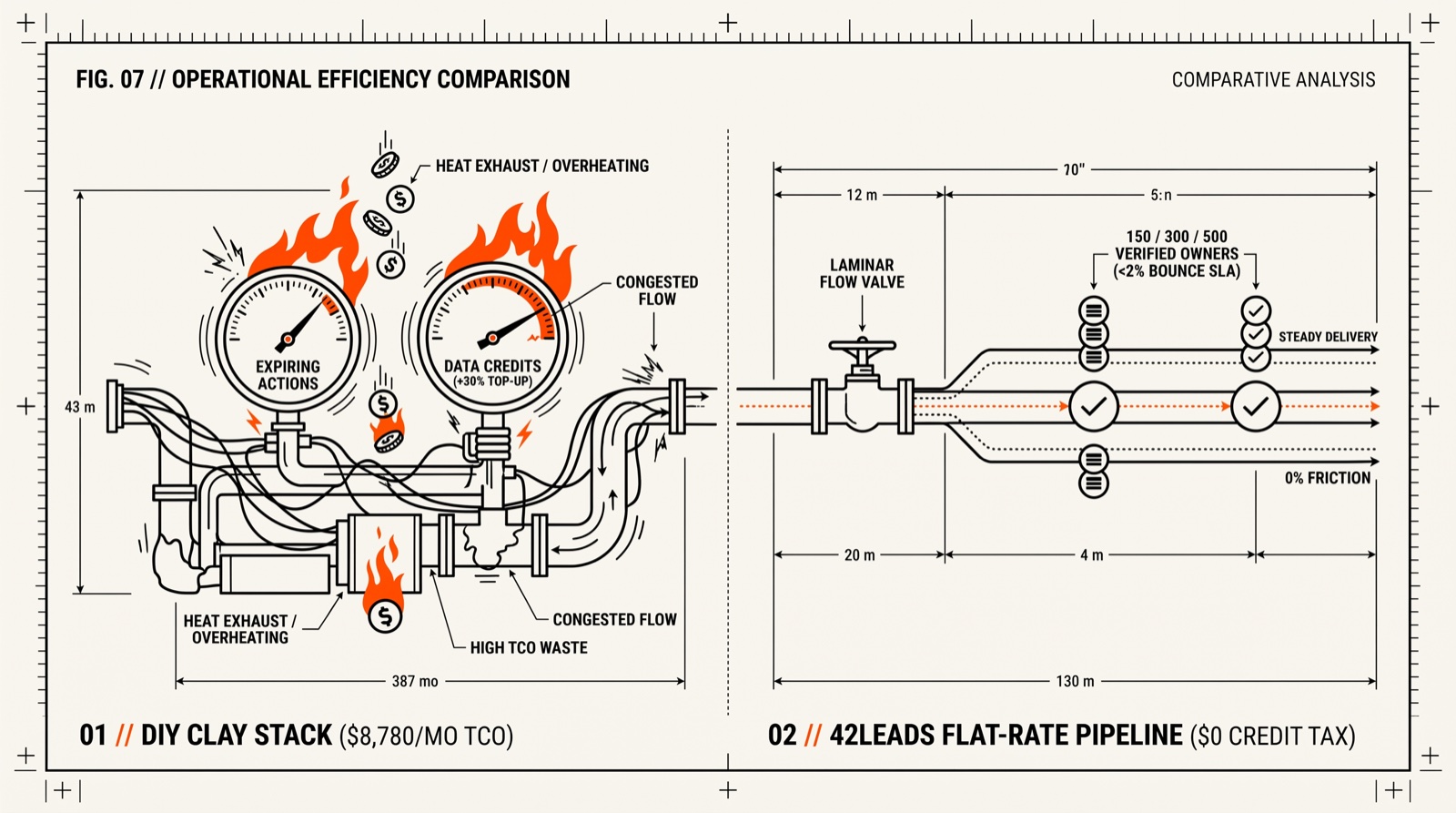
Clay’s March 11, 2026 pricing overhaul replaced single-pool credits with a dual-meter model—pairing expiring platform Actions (0% monthly rollover) with Data Credits carrying a 30% mid-cycle top-up penalty—pushing a mid-volume Growth plan (100,000 Actions + 20,000 Data Credits) to $1,330/month before external APIs or labor. Once teams add scrapers, proxies, catch-all verifiers, mailboxes, and 10 to 20 hours per week of a $150,000/year GTM Engineer, the true in-house DIY stack costs $6,235 to $11,430/month ($8,780/month midpoint), while certified “Claygencies” average $9,280/month under 3-to-6-month lock-ins. For B2B teams targeting 150 to 500 verified US decision-makers per month, flat-rate signal batches ($980 to $2,450/month with $0 software seats and a <2% bounce SLA) cut total data TCO by 75% to 85% while keeping 100% client custody of every record.
How Did Clay’s March 11, 2026 Dual-Meter Overhaul Change Outbound Unit Economics?
On March 11, 2026, Clay retired its legacy single-pool credit tiers and introduced a split infrastructure billing model across self-serve Launch ($185/month monthly; $167/month annual), Growth ($495/month monthly; $446/month annual), and custom Enterprise contracts. While marketplace unit rates on select commodity data lookups dropped by 50% to 90% and zero-result waterfall lookups remained unbilled, adding a second mandatory execution meter fundamentally changed the unit economics of multi-step data engineering.
Every Clay workspace is now metered simultaneously across two separate ledgers: Data Credits and Actions. Data Credits purchase third-party company and contact attributes across Clay’s marketplace of 150+ providers, starting at $0.05 per credit at entry tiers. Unused Data Credits roll over up to a hard ceiling of 2x the monthly plan allowance on Launch and Growth (15% annual rollover on Enterprise), and mid-cycle credit top-ups incur an immediate 30% premium penalty above standard plan rates.
Simultaneously, Actions meter every discrete unit of platform orchestration: firing an HTTP API call, invoking an LLM prompt, running a conditional enrichment step, parsing a webhook, or syncing a row to HubSpot, Salesforce, or an outbound sequencer. Unlike Data Credits, unused Actions expire at 0% rollover at the close of every billing cycle, and workspaces cannot purchase one-time Action top-ups mid-month without upgrading their recurring Action tier.
Why Does the BYOK Action Tax Penalize Engineering-Led Teams?
Prior to March 2026, technical revenue teams treated Clay as a low-cost orchestration canvas by bringing their own external API keys (BYOK) for OpenAI, Anthropic, Hunter, Anymail Finder, and MillionVerifier via HTTP API columns—paying external wholesale rates while consuming zero Clay credits. Under the 2026 architecture, every step executed with a customer’s own external API keys consumes 1 Action per row. You pay your external API vendor invoice and pay Clay an orchestration tax on every intermediate cell evaluation.
Worse still is the Growth Plan Action Markup Anomaly. Connecting external web scrapers via HTTP API, receiving inbound webhooks, or auto-syncing records to a CRM is completely locked out of the $185/month Launch plan ($125 Data Credits for 2,500 Credits + $60 Actions for 15,000 Actions). Upgrading to the $495/month Growth base plan ($290 Data Credits for 6,000 Credits + $205 Actions for 40,000 Actions) unlocks HTTP and CRM integrations, but quietly inflates the price of identical Action bundles by 36% to 57%:
- 40,000 Monthly Actions: $150/month on Launch vs. $205/month on Growth (+$55/month markup).
- 100,000 Monthly Actions: $290/month on Launch vs. $450/month on Growth (+$160/month markup).
- 200,000 Monthly Actions: $540/month on Launch vs. $850/month on Growth (+$310/month surcharge for the exact same execution compute).
Compounding the Action markup, Clay split AI model billing in March 2026. While lightweight classification models remain on flat rates, frontier reasoning models—specifically GPT-5.1 and Claude 4.6 Sonnet—pass through variable raw token consumption directly against Data Credits. When teams crawl multi-page local clinic websites or parse unstructured customer reviews, variable token burn drains Data Credits alongside expiring Actions. Across 97 verified enterprise procurement contracts tracked by Vendr, the median annual Clay Enterprise contract stands at $59,993/year (spanning $16,560 to $166,800/year).
Inspect What Arrives Without Managing a 10-Column Waterfall Table
Verbatim Public Signal: 1★ Google Review: “Called four times Tuesday morning to book an emergency pediatric exam—transferred twice and disconnected.” Paid search active; no web booking widget.
Verbatim Public Signal: 1★ Facility Review: “Warehouse RTU compressor failed at 7 AM—dispatch promised a callback and left us waiting 28 hours.” Static contact form; no urgent triage routing.
Verbatim Public Signal: 2★ Patient Review: “Filled out the Instagram laser consultation form twice and never received pricing or a callback.” Meta Pixel firing; zero automated SMS response.
Want 5 live, unmasked signal leads in your exact vertical?
Request Your Free 5-Lead Sample Batch →Why Does an In-House DIY Clay Stack Actually Cost $8,780/Month?
Evaluating DIY outbound orchestration by looking solely at Clay’s $495/month Growth base price mistakes an empty workbench for a finished factory. Clay neither scrapes raw local business registries natively nor dispatches cold email campaigns. Delivering 5,000 verified local or regulated SMB decision-makers per month requires processing roughly 10,000 raw records—because 30% to 50% of main-street listings lack websites, hide executive identities behind front-desk switchboards, or resolve exclusively to generic info@ role addresses.
Running 10,000 records across a 10-step enrichment workflow (website DOM fetch, CMS NPI or Secretary of State registry lookup, GPT-5.1 owner resolution, LinkedIn tenure check, four-vendor email waterfall, catch-all SMTP verification, AI opener generation, and webhook export) consumes approximately 100,000 Actions ($450/month) and 20,000 Data Credits ($880/month), placing the recurring Clay subscription at $1,330/month before any mid-cycle 30% credit top-ups.
Around that $1,330/month core, an internal operations team must fund five additional infrastructure and labor layers:
- External Scraper & BYOK Waterfall APIs ($250–$550/month): Directory actors, Outscraper or D7 subscriptions ($119.99/month), secondary email finders (Hunter, Tomba, FullEnrich), and direct LLM token invoices.
- Rotating Residential Proxies & Headless Compute ($100–$250/month): Required to crawl clinic websites, state licensing portals, and corporate imprints without triggering Cloudflare or WAF blocks.
- Dedicated Multi-Layer & Catch-All Verification ($105–$300/month): Standalone MillionVerifier pools and dedicated catch-all resolution gates to isolate delayed catch-all bounces before sequence injection.
- Sequencer, Secondary Domains & Warmed Mailboxes ($250–$600/month): Smartlead or Instantly ($97–$297/month) plus 20 secondary domains and 60 warmed Google Workspace or Microsoft 365 inboxes.
- Allocated US GTM Engineering Labor ($4,200–$8,400/month): Per RevGuild’s 2026 compensation benchmark, a US Go-To-Market Engineer commands a median $150,000/year base salary ($15,625/month fully burdened with benefits and payroll taxes, or ~$97.65/hour). Debugging broken regex selectors, handling API rate limits, auditing AI hallucinations, and tuning waterfalls requires 10 to 20 hours every week (43 to 86 hours/month).
Combining $2,035 to $3,030/month in hard software and proxy bills with $4,200 to $8,400/month in allocated GTM engineering time produces a fully loaded DIY TCO of $6,235 to $11,430/month ($8,780/month midpoint) before a single sales rep picks up the phone.
What Is the “Claygency” Workspace Lock-In Trap?
When internal teams hit the six-week conditional-formula learning curve, many pivot to hiring a certified Clay agency (“Claygency”). Published 2026 retainers range from $5,000 to $25,000/month ($7,500/month typical mid-market studio) under mandatory 3-to-6-month lock-ins, while still billing clients separately for their own Clay Growth workspace and third-party APIs—bringing loaded monthly spend to a $9,280/month midpoint. Worse, agencies routinely build pipelines inside the agency’s master parent workspace: cancel at Month 6, and your team walks away with a static CSV export while forfeiting $30,000 to $60,000 worth of enrichment logic and dedup ledgers overnight (see our full 18-Agency Clay Studio Rate-Card & Custody Audit).
| Cost Component / Risk Layer | In-House DIY Clay Stack | Certified US “Claygency” | 42leads Flat Signal Batches |
|---|---|---|---|
| Core Platform Subscription | $1,330/mo (Growth: 100k Actions + 20k Credits; $59,993/yr Ent. median) | $495–$1,330/mo (Client funds own Clay Growth workspace) | $0/mo (Zero software seats or Action meters) |
| Scrapers, Proxies & Verifiers | $455–$1,100/mo (External APIs, residential proxies, catch-all checks) | $200–$450/mo (Third-party API & verifier pass-throughs) | $0/mo (Crawlers, proxies & live SMTP included) |
| Sending Domains & Mailboxes | $250–$600/mo (Sequencer + 20 domains + 60 warmed inboxes) | $0–$300/mo (Varies by build-only vs. managed scope) | Plugs directly into your existing sequencer/CRM |
| Engineering Labor / Retainer | $4,200–$8,400/mo (10–20 hrs/wk of $150k/yr GTM Engineer) | $5,000–$25,000/mo ($7,500/mo typical mid-market studio) | Included ($0 internal engineering maintenance) |
| Lock-In & Asset Custody | 0% Action rollover; 30% Credit top-up penalty; dead-row waste | 3–6 Month Lock-In ($15k–$60k+); agency owns parent tables | $0 Setup on 3M/6M/12M · 100% client data custody |
| Fully-Loaded Monthly TCO | $6,235–$11,430/mo ($8,780 midpoint) | $5,695–$27,080/mo ($9,280 midpoint) | $980–$2,450/mo (150–500 Verified Leads) |
When Should a B2B Team Replace Orchestration SaaS With Flat Signal Batches?
Clay remains an exceptional workbench for enterprise organizations employing full-time GTM engineers who enrich tens of thousands of inbound PLG signups every month. However, if your commercial objective is equipping 1 to 4 Account Executives or SDRs with verified US decision-makers experiencing documented operational pain, paying $8,780/month for DIY plumbing or $9,280/month for a locked-in Claygency is capital misallocation.
At 42leads, we absorb 100% of crawler compute, proxy rotation, unstructured review extraction, active Owner/CEO resolution (0% info@ in primary rows), and two-stage live SMTP verification inside our PostgreSQL and n8n pipeline. You pay strictly for verified deliverables on flat monthly tiers:
- Core Pipeline (
150verified US leads/mo): $980/month standard (-10%on 6-month plans;-15%on 12-month annual plans). - Scale Pipeline (
300verified US leads/mo · Most Popular): $1,650/month standard—15 verified decision-maker rows per working day. - High-Velocity (
500verified US leads/mo): $2,450/month standard—built for multi-rep outbound floors (custom enterprise batches scoped on request).
Setup is $0 USD on all 3-month, 6-month, and 12-month plans ($750 one-time setup applies only on a 1-Month Flex-Test), backed by a contractual <2% bounce SLA with 1-for-1 replacement and a 90-day territory lock. Skip the Action-credit tax and test our output first via a Free 5-Row Custom Sample ($0, unmasked CSV, zero sales calls).
Three Buyer Questions on Clay 2026 Metering & TCO
1. Did Clay’s March 11, 2026 pricing update make BYOK (Bring Your Own API Key) workflows free?
No. Prior to March 11, 2026, calling external APIs with your own keys consumed zero Clay credits once HTTP integrations were unlocked. Under the 2026 dual-meter model, every workflow step executed with your own API keys consumes 1 Action per row, and unused Actions expire at the end of every billing cycle with 0% rollover.
2. Why does the exact same Action volume cost up to $310/month more on Clay Growth than on Clay Launch?
Clay gates HTTP API integrations, webhooks, and CRM auto-sync behind the Growth tier ($495/month base). Once upgraded to Growth, unit rates on Action bundles increase by 36% to 57% compared to Launch: 40,000 Actions rise from $150 to $205/month, 100,000 Actions rise from $290 to $450/month, and 200,000 Actions rise from $540 to $850/month—a $310/month platform surcharge on identical execution compute.
3. What happens to our tables and deduplication history when we cancel a Claygency retainer?
Most certified Clay agencies build client workflows inside the agency’s centralized multi-tenant parent workspace to share proprietary prompt libraries and agency API tiers. When a 3-to-6-month retainer ends, workspace access is revoked and you typically walk away with only a static CSV export, forfeiting the underlying HTTP schemas, waterfall rules, and historical deduplication ledgers.
Replace $8,780/mo DIY spreadsheet overhead with a Free 5-Row Custom Sample ($0, unmasked CSV, zero sales calls).