
The 18% Bounce Trap: Why “Verified” Database Lists Burn Domain Reputation on Catch-All Servers (And How to Recover 42% More Pipeline)
Why standard SMTP 250 OK handshakes fail across 30%–40% of B2B corporate mail gateways—and what a 1,000-email empirical benchmark reveals about locking hard bounce rates between 0.59% and 0.85%.
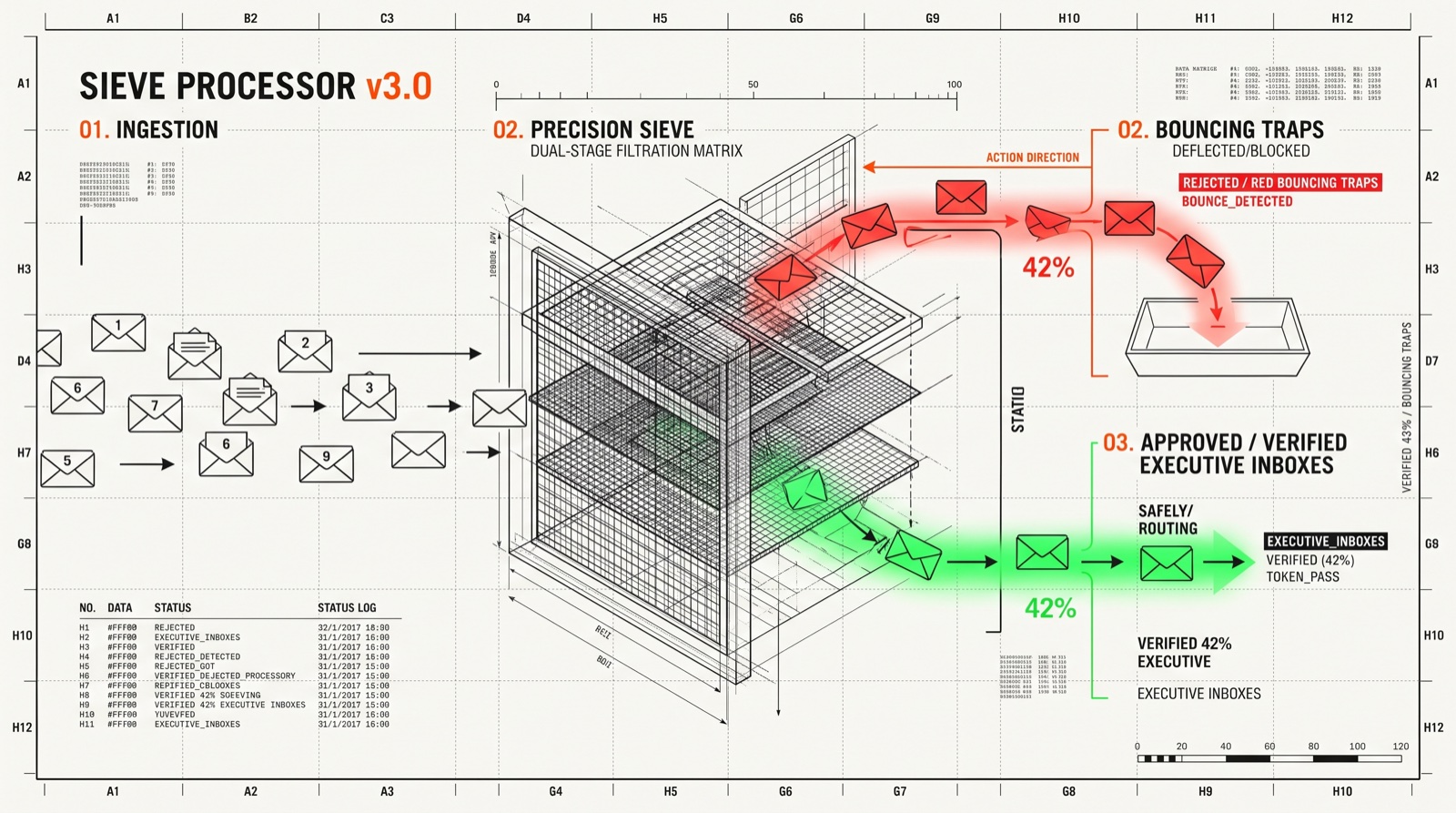
B2B database exports marked “Verified” by basic syntax, MX, and SMTP checks still trigger up to 18% hard bounces because 30% to 40% of corporate domains run catch-all (accept-all) mail gateways that return a false-positive 250 OK for every address—even long after an executive leaves. Yet blindly deleting all catch-all rows destroys up to 42% of valid, high-ACV decision-maker pipeline. Deploying dual-stage catch-all verification—combining tarpit-aware SMTP handshakes with non-sending identity-provider and gateway telemetry—retains 82% to 85% of total prospect pools while locking actual hard bounces below 1%.
Why Do Standard SMTP 250 OK Handshakes Fail on 30% to 40% of B2B Corporate Domains?
Standard email verification tools validate a corporate address across three sequential steps: RFC syntax parsing, DNS Mail Exchange (MX) and SPF lookup, and an unauthenticated Simple Mail Transfer Protocol (SMTP) conversation (EHLO → MAIL FROM → RCPT TO → QUIT) terminated immediately prior to the DATA command. On consumer mail providers or unguarded small-business servers, an invalid recipient elicits an immediate 550 5.1.1 User Unknown rejection during RCPT TO, allowing the verifier to drop the bad address cleanly.
In mid-market and enterprise B2B outbound, however, this classic SMTP probe collides with anti-harvesting security policies. To prevent spammers and directory scrapers from brute-force enumerating employee naming conventions via dictionary attacks, 30% to 40% of B2B corporate mail gateways—particularly Microsoft 365 Exchange Online, Google Workspace enterprise routing, Proofpoint, and Mimecast—are configured as catch-all (accept-all) servers. When a standard verifier probes nonexistent.ceo@company.com, the gateway intentionally replies 250 2.1.5 OK during the handshake, accepts the message into an internal inspection queue once DATA is sent, and dispatches an asynchronous Non-Delivery Report (NDR) hard bounce minutes or hours later.
Two operational realities turn that catch-all blind spot into a domain trap:
- SMTP Tarpitting Timeouts: Enterprise gateways frequently deploy SMTP tarpitting—deliberately injecting multi-second delays between
EHLOandRCPT TOresponses so cheap bulk verifiers time out and misclassify valid or invalid mailboxes as “unknown.” - 2.1% Monthly Contact Decay Behind Accept-All Shields: As documented in our B2B Data Decay & 95:5 Intent Audit, corporate contacts decay at 2.1% per month (22.5% to 30.0% annually)—invalidating 12,000 to 15,000 records per year in a 50,000-row database. When an executive departs a company behind a Microsoft 365 or Mimecast catch-all gateway, unauthenticated probes keep returning
250 OKlong after the inbox is deactivated, causing cached “Verified” lists to suffer up to an 18% hard bounce rate (nine times higher than Google and Microsoft’s 2.0% reputation ceiling).
Click any row to inspect how catch-all executive inboxes are verified before CSV drop
Want 5 live, unmasked signal leads in your exact vertical?
Request Your Free 5-Lead Sample Batch →Why Does Deleting All Catch-All Domains Destroy 42% of Recoverable Executive Pipeline?
Once an outbound team gets burned by catch-all bounces, the knee-jerk reaction in Smartlead, Instantly, or Clay is to toggle a blanket rule: “Drop all catch-all / risky emails and send only to non-catch-all valid rows.” While that blunt filter protects sender reputation, it inflicts massive silent damage on unit economics. Empirical catch-all validation data confirms that up to 42% of catch-all corporate emails are active, deliverable decision-maker inboxes.
Think through the selection bias of who enables catch-all gateways in the first place. Established multi-location clinics, mid-market SaaS vendors, commercial contractors with dedicated IT managed service providers, and security-conscious enterprises disproportionately run Microsoft 365 or Proofpoint catch-all configurations. Deleting every catch-all domain means throwing away nearly half of your highest-ACV accounts—even after you already paid enrichment compute to source the company, extract its public pain signal, and identify the CEO—while simultaneously skewing your remaining outreach toward tiny, unguarded domains that 50 competing SDRs are already emailing.
What Did the 2026 1,000-Email Catch-All Benchmark Reveal Across Verification Engines?
To escape the false choice between 18% domain-burning bounce spikes and 42% pipeline destruction, modern deliverability pipelines add a fourth hygiene layer after syntax, MX, and tarpit-aware SMTP: catch-all telemetry and gateway resolution. Note an important architectural distinction among catch-all tools: sacrificial burner-email senders like Scrubby dispatch live probe emails and wait 24 to 72 hours for bounce receipts—which works on standard servers, but triggers silent-drop false positives on Proofpoint and Mimecast whenever a security gateway swallows a suspicious burner message without emitting a bounce notice. By contrast, non-sending Identity Provider (IdP) and gateway latency triangulation combining Enterprise Identity-Directory Telemetry Probes, L42 Dual-Stage ESG Latency Triangulation, and a Proprietary Catch-All Resolution Gate validates catch-all mailboxes in real time without polluting executive inboxes.
In a controlled 2026 empirical benchmark across 1,000 corporate B2B emails heavily weighted toward catch-all domains, strict legacy verifiers retained only 711 leads (discarding 289 prospects). By contrast, single-stage Enterprise Identity-Directory Telemetry Probes safely approved 822 leads with just 7 bounces (0.85% bounce rate), and L42 Dual-Stage ESG Latency Triangulation paired with our Proprietary Catch-All Resolution Gate approved 852 leads with only 5 bounces (0.59% bounce rate)—recovering up to 141 net deliverable decision-makers per 1,000 rows (+19.8% total list yield) while holding hard bounces well under 1%.
| Verification Strategy / Engine | Leads Approved (of 1,000) | Actual Hard Bounces | Realized Bounce Rate | Validation Cost (per 10k) | Pipeline & Domain Impact |
|---|---|---|---|---|---|
Unresolved SMTP 250 OK Export |
~920+ | ~165 | 18.00% | Bundled / Cached | Immediate domain blacklisting & multi-week inbox recovery |
| Strict Legacy Verifier (Drop Catch-Alls) | 711 | <7 | <1.00% | $40.00 – $65.00 | Safe sender score, but discards 289 leads (wastes 42% valid catch-alls) |
| Scrubby (Burner Probe Emails) | Catch-All Subset | Silent-Drop Risk | 1.30% – 4.5%+ (ESGs) | $200+ / 24–72h wait | Sends real burner probes; Proofpoint/Mimecast silent drops cause false positives |
| Enterprise Identity-Directory Telemetry Probes | 822 | 7 | 0.85% | ~0.25x Burner Cost | Recovers +111 extra decision-makers below 1% bounce threshold |
| Proprietary Catch-All Resolution Gate | 852 | 5 | 0.59% | Included in Flat Tier Rate | High net retention (+141 leads vs. legacy) at sub-0.6% bounce |
| L42 Dual-Stage ESG Latency Triangulation | ~845–860 (0% info@) |
1-for-1 Replaced | <0.80% (<2% SLA) | Included ($0 Client Credit Tax) | Non-sending IdP + ESG latency + point-of-delivery SMTP built into every batch |
How Does a Canary Subdomain Protocol Isolate Residual Unresolvable Catch-Alls?
Even after multi-provider catch-all verification, roughly 5% to 8% of enterprise accounts may return conflicting telemetry scores. Disciplined outbound architects never inject uncertain catch-all addresses into their core warm inbox pool. Instead, primary outbound sequences run on dedicated secondary lookalike domains authenticated with strict SPF, DKIM, and DMARC policies (capped under 30 plain-text emails per day per inbox with tracking pixels disabled), while any residual ambiguous catch-all contacts are routed in low-volume micro-batches through isolated canary subdomains. If a mailbox passes canary delivery without an asynchronous NDR over 72 hours, the executive contact promotes cleanly into the CRM; if it bounces, your primary sending domains suffer zero reputation drag.
How Does 42leads Guarantee a <2% Hard Bounce SLA with 1-for-1 Replacement?
Maintaining multi-vendor SMTP handshakes, tarpit retry queues, and catch-all verification across separate billing dashboards is an operational distraction for lean revenue teams. At 42leads, point-of-delivery email hygiene is built directly into every extraction run—eliminating generic info@, sales@, and office@ role accounts (0% info@ in primary rows) and backing every batch with a contractual <2% hard bounce guarantee and 1-for-1 replacement:
- Core Pipeline (
150verified US leads/mo): $980/mo standard (-10%on 6-month plans;-15%on 12-month annual plans). - Scale Pipeline (
300verified US leads/mo · Most Popular): $1,650/mo standard—15 verified decision-maker rows per working day. - High-Velocity (
500verified US leads/mo): $2,450/mo standard—built for multi-rep outbound pods (custom enterprise volumes scoped on request).
All 3-month, 6-month, and 12-month commitments include $0 USD setup ($750 setup applies only on 1-Month Flex-Test runs) and a 90-day territory lock per batch. Benchmark our catch-all hygiene against your current database vendor first with a Free 5-Row Custom Sample ($0, unmasked CSV, zero sales calls).
Catch-All Verification & Bounce Protection FAQ
250 OK for departed employees—generating asynchronous hard bounces only when a real email is transmitted.
<2% bounce SLA. Any verified hard bounce above that threshold is replaced 1-for-1 in your next scheduled batch at zero extra cost.
Test 5 live, catch-all-verified Founder & Owner emails in your exact US vertical—100% free, zero sales calls.