
The Half-Life of B2B Intent: Quantifying the 2.1% Monthly Data Decay Curve, the 95:5 Rule, and the 72-Hour Trigger Multiplier
Why static quarterly database exports mathematically guarantee domain throttling at 6.17% decay—and how isolating the 3%–5% of accounts with verified operational pain unlocks a 10x to 30x reply multiplier.
Every static quarterly CSV export is a deliverability time bomb: B2B contact records decay at 2.1% per month (22.5% to 30.0% per year), meaning a 90-day list accumulates 6.17% dead mailboxes—more than 3x above the 2.0% hard-bounce ceiling where inbox providers throttle your domain. Worse, the Ehrenberg-Bass 95:5 Rule shows that 95% of B2B companies are out-of-market at any moment while only 3% to 5% face an urgent operational problem, trapping generic firmographic sequences at 0.14% to 0.50% reply rates. Isolating accounts with verified public customer pain and running live SMTP hygiene right before batch delivery lifts reply rates to 1.5%–6.0%+ (10x to 30x lift) while sending 90% fewer emails.
Why Does a 90-Day Static CSV Snapshot Breach the 2.0% Bounce Ceiling by More Than 3x?
Subscription B2B contact brokers (Apollo, ZoomInfo, Lusha) are built on a flawed premise: that executive contact data can be crawled once, cached for six months, and resold to thousands of SDRs simultaneously. In reality, corporate inboxes erode every single week through job changes, M&A domain migrations, role reassignments, and local business closures. US Bureau of Labor Statistics (BLS) data confirms that 22% of wage and salary workers have been with their current employer for one year or less, with median tenure among professionals aged 25 to 34 sitting at just 2.7 years.
Benchmarks from Dun & Bradstreet and Gartner measure this contact decay at 2.1% per month, compounding to 22.5% to 30.0% per year across general B2B verticals (and over 30% in tech and agencies), leaving 91% of typical CRM records incomplete, stale, or duplicated. Compounded over a single 90-day quarter, 6.17% of previously valid mailboxes go dead. In a 50,000-contact CRM, job churn invalidates 12,000 to 15,000 contacts every twelve months; on a weekly cold email send, a 6.17% bounce rate exceeds the 2.0% safety ceiling by 3.08x and crosses the 5.0% automated sequencer suspension threshold.
Worse still, static database “Verified” badges routinely reflect cached SMTP handshakes executed 60 to 180 days earlier rather than live point-of-send checks. When an executive leaves a company in Month 2, corporate IT administrators typically forward the inbox for 30 days before deprovisioning it into a hard 550 5.1.1 User Unknown rejection—or, on abandoned legacy domains, allowing anti-abuse networks to convert the dead address into a recycled spam trap. Every week a CSV sits unverified on a laptop, Google Postmaster Tools and Microsoft SNDS reputation risk compounds nonlinearly.
2★ Distributor Review: “Warranty PLC replacement tickets sit unanswered for 9 business days with zero portal status updates.” Paid search active on industrial retrofit keywords.
1★ Google Review: “Filled out their laser resurfacing pricing form twice—never got a text or callback.” Meta Pixel active; zero automated SMS follow-up.
1★ Property Manager Review: “After-hours answering service took our emergency server-room AC ticket Friday night and lost the message until Monday.”
Want 5 live, unmasked signal leads in your exact vertical?
Request Your Free 5-Lead Sample Batch →How Does the Ehrenberg-Bass 95:5 Rule Explain 0.14%–0.50% Static Cold Reply Rates?
Even if a static database export were 100% deliverable, firmographic cold blasting still collides with Professor John Dawes's 95:5 Rule at the Ehrenberg-Bass Institute. Empirical B2B category research proves that up to 95% of businesses in a target market are out-of-market at any given moment, leaving only 3% to 5% actively in-market to evaluate or purchase a solution.
When an SDR team exports 10,000 companies filtered solely by NAICS code and headcount, 9,500 to 9,700 of those executives have zero immediate operational reason to switch vendors. Combined with ~25% annualized mailbox decay, cold static sequences in 2026 average baseline reply rates of just 0.14% to 0.50%—burning secondary sending domains to book a handful of reluctant discovery calls.
Why Does the 24-to-72-Hour Trigger Window Generate a 10x to 30x Conversion Multiplier?
Transitioning into the 3% to 5% active buying window is rarely random; it is precipitated by an observable operational disruption—a public 1★ or 2★ customer review exposing dropped calls or botched service, a statutory executive change in the commercial register or CMS NPPES, or paid search traffic leaking onto a landing page missing booking infrastructure.
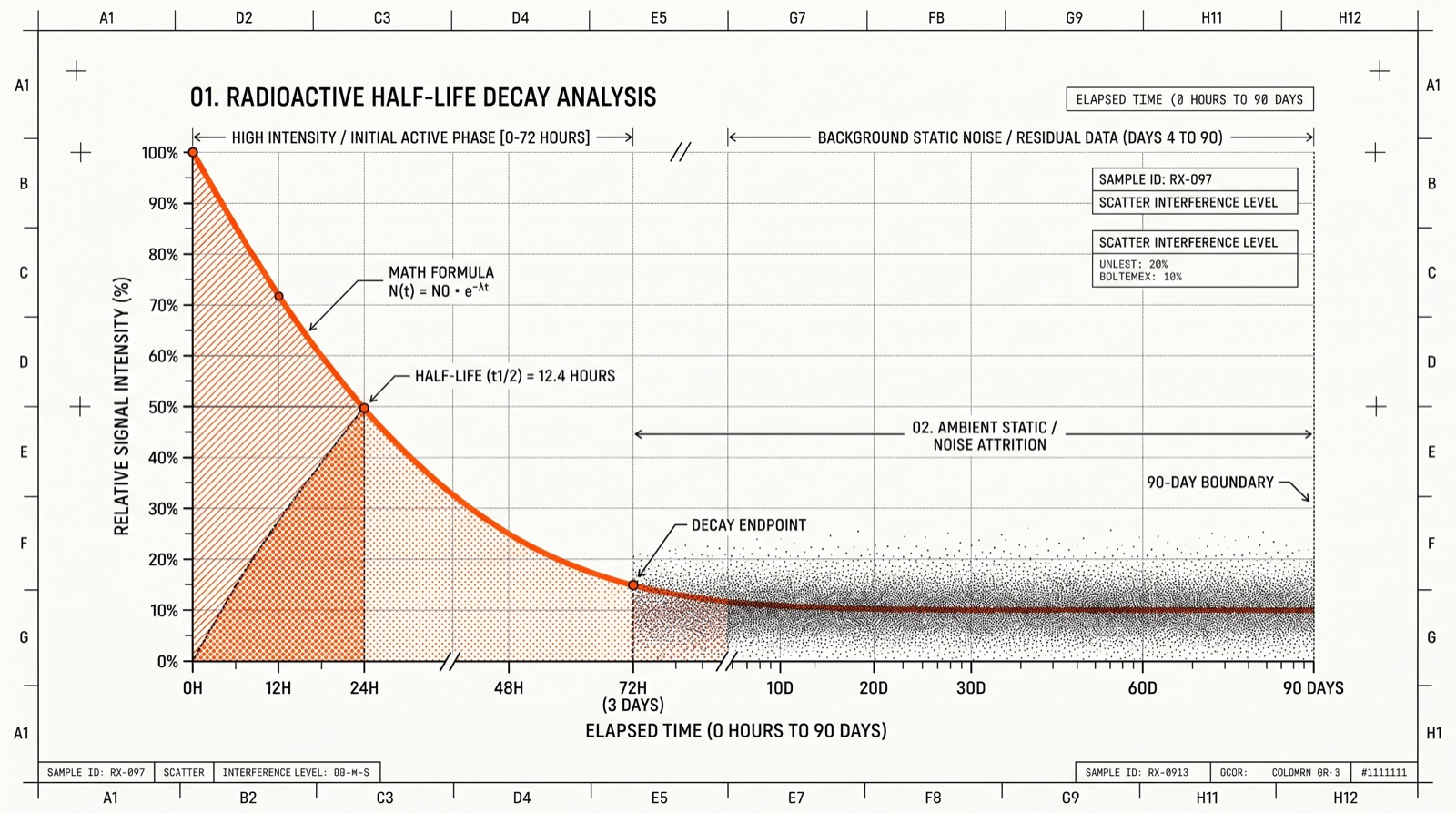
Crucially, executive urgency follows a steep Intent Half-Life (plotted in FIG. 14 below). When a founder or managing partner experiences an acute customer-facing failure, psychological urgency peaks within the first 24 to 72 hours—driving reply rates from the 0.14%–0.50% cold baseline up to 1.5% to 6.0%+ (10x to 30x lift)—before fading steadily as the team improvises a manual workaround or normalizes the revenue leak.
Look at how this math inverts outbound infrastructure requirements. Blasting 10,000 firmographic contacts from a 90-day database snapshot at a 0.20% reply rate yields roughly 20 replies—mostly polite rejections—while detonating 617 hard bounces (6.17%) across 15 to 20 disposable burner domains. Conversely, shipping 500 freshly verified accounts filtered exclusively for the 3% to 5% experiencing active operational pain at a 4.0% reply rate generates 20 high-context buying conversations while producing fewer than 10 bounces (<2.0% SLA)—cutting email send volume by 95% and keeping primary sending domains healthy for years.
| Data & Signal Age | Cumulative Contact Decay | Records Corrupted (Per 50k CRM) | ESP Reputation Impact | Expected Outbound Reply Rate |
|---|---|---|---|---|
| Point-of-Discovery (24–72h Trigger) | <0.85% – <2.0% (Live SMTP) | 0 Cached Leftovers | Protected (<2.0% SLA + 1:1 Replace) | 1.50% – 6.00%+ (10x–30x Lift) |
| 30 Days (1-Month Export) | 2.10% | 1,050 invalid contacts | Breaches 2.0% hard-bounce warning line | 0.80% – 1.60% (Urgency fading) |
| 90 Days (1 Quarterly Snapshot) | 6.17% (3.08x over 2% cap) | 3,084 invalid contacts | Breaches 5.0% sequencer suspension ceiling | 0.25% – 0.50% (95% out-of-market) |
| 180 Days (6-Month Cached Badge) | 11.96% | 5,980 invalid contacts | Severe Google Postmaster / SNDS throttling | 0.14% – 0.35% |
| 365 Days (Annual Database Seat) | 22.49% – 30.0%+ | 12,000 – 15,000 invalid contacts | Domain burn + spam-trap contamination | <0.14% (Near-zero inbox placement) |
Why Are $60,000/Year Reverse-IP Intent Platforms Blind to Real-World Operational Pain?
Enterprise revenue leaders often try to solve the 95:5 problem by signing $60,000/year reverse-IP intent subscriptions (Bombora co-ops, 6sense, Demandbase). Outside the Fortune 1000, black-box IP scores fail due to two structural flaws: IP Resolution Failure on remote residential fiber and shared cellular networks, and the End-Customer vs. Buyer Paradox. When a multi-doctor dental group drops patient transfer calls or a 38-truck HVAC fleet misses a rooftop chiller callback, the owner does not go read five B2B whitepapers—their customers broadcast the operational breakdown publicly in verbatim 1★ and 2★ reviews.
Even when an enterprise IP block resolves cleanly, third-party publisher co-ops hand SDRs an opaque numeric score (“Account Surging: 82/100 on Cloud Workflow”) devoid of persona attribution or actionable copy context. Referencing anonymous web-browsing telemetry in a cold email immediately triggers executive privacy backlash, whereas citing a public landing-page conversion gap or a pattern of customer-reported scheduling bottlenecks anchors a consultative, high-trust conversation from Sentence One.
How Does Point-of-Batch Extraction Eliminate Quarterly Decay and Software Bloat?
Solving both halves of the decay problem—monthly contact rot (2.1%/month) and buyer urgency fade—requires moving verification out of a static multi-tenant warehouse to the exact moment of batch assembly. When every target domain is crawled fresh for public operational pain proof, resolved against authoritative corporate or clinical registries, and passed through a live two-stage SMTP handshake immediately before export, bounce exposure drops safely below the 2.0% ESP safety ceiling.
Instead of renting decayed warehouse exports or overpaying for noisy IP co-ops, 42leads runs fresh extraction and two-stage live SMTP + catch-all verification right before delivering your ready-to-send CSV or single-tenant Google Sheet on a calm monthly or bi-weekly cadence:
- Core Pipeline (150 verified US leads/mo): $980/month ($882/mo on 6-month plans; $833/mo on annual).
- Scale Pipeline (300 verified US leads/mo · Most Popular): $1,650/month ($1,485/mo on 6-month plans; $1,402/mo on annual).
- High-Velocity Pipeline (500 verified US leads/mo): $2,450/month ($2,205/mo on 6-month plans; $2,082/mo on annual).
All 3-month, 6-month (-10%), and 12-month (-15%) plans include a $0 setup fee ($750 setup applies only on a 1-Month Flex-Test), 0% info@ in primary rows, a 90-day territory lock, and a strict <2% bounce SLA (1-for-1 replacement).
B2B Data Decay & 95:5 Intent Math FAQ
Test 5 freshly verified, unmasked US pain-signal & owner leads in your exact niche—$0, no credit card, zero sales calls.