
Enterprise Identity-Directory Telemetry & ESG Latency: How We Verify Catch-All Emails Without Burning Domains
Why sacrificial probe-email services trigger silent gateway blackholes across Proofpoint and Mimecast—and how decoupling Enterprise Identity-Directory Telemetry Probes from L42 Dual-Stage ESG Latency Triangulation achieves a 0.74% real-world bounce rate without sending a single probe email.
Across modern B2B outbound, 45% to 55% of corporate domains enforce Catch-All RCPT TO: 250 OK policies or route mail behind Enterprise Email Security Gateways—led by Proofpoint (87 of the Fortune 100), Mimecast, Barracuda, and Cisco IronPort—blinding basic SMTP verifiers into discarding half your addressable market. Sacrificial probe-email tools like Scrubby (24–72h batch stall) suffer dangerous false positives whenever Proofpoint or Mimecast silently drops blank burner probes without returning a bounce notice, while SaaS login enumerators (Findymail / Prospeo) misclassify departed employees’ orphaned Trello or Dropbox accounts as active work emails. By pairing non-sending Enterprise Identity-Directory Telemetry Probes with L42 Dual-Stage ESG Latency Triangulation (+120ms to +450ms timing deltas) inside our Proprietary Catch-All Resolution Gate, our pipeline recovers 55.2% of valid catch-all executive mailboxes at a 0.74% real-world bounce rate—delivering >90% waterfall waste reduction (~0.1x baseline compute) included in every flat monthly tier with a $0 client credit tax.
Why Do 45%–55% of B2B Corporate Domains Defeat Standard Port 25 SMTP Handshakes?
During a classical RFC 5321 mail-server check (CONNECT → EHLO → MAIL FROM → RCPT TO → RSET), legacy verifiers such as ZeroBounce, NeverBounce, and MillionVerifier rely on a single assumption: that the receiving Mail Exchange (MX) host will truthfully return 550 5.1.1 User Unknown when an email address does not exist. In 2026 B2B infrastructure, that assumption fails across 45% to 55% of mid-market, healthcare, industrial, and enterprise domains.
To defeat automated directory harvesting and protect internal executives from spear-phishing reconnaissance, IT administrators deploy two perimeter defenses. First, Microsoft 365 and Google Workspace administrators enable domain-wide Catch-All (accept-all) routing on port 25 so every syntactically valid RCPT TO command returns 250 2.1.5 OK regardless of whether the mailbox exists. Second, security-conscious organizations place an inline Enterprise Email Security Gateway (ESG) in front of their MX records—specifically Proofpoint (pphosted.com, guarding 87 of the Fortune 100), Mimecast (mimecast.com), Barracuda, or Cisco Secure Email / IronPort (iphmx.com).
Faced with a 250 OK catch-all banner, single-stage SMTP verifiers achieve 0% catch-all resolution and bucket the entire cohort as accept_all or risky. Revenue teams are then trapped between two expensive errors: suppressing every catch-all domain—instantly forfeiting 40%+ of valid Founders, Managing Partners, and VPs—or mailing unverified catch-all permutations blindly and suffering an 18%+ hard bounce rate that blacklists secondary sending domains within days.
Click any catch-all or ESG-protected US row to inspect Identity-Directory & ESG latency triangulation proof
Want 5 catch-all-verified US Founder & Owner rows in your exact market?
Request Your Free 5-Lead Sample Batch →Why Do Sacrificial Probe-Email Senders (Scrubby) and SaaS App Enumerators Break on Enterprise Domains?
To work around catch-all servers, outbound teams have historically leaned on sacrificial probe-email services or consumer SaaS login enumerators. Across five competing catch-all verification paradigms in the market, two popular shortcuts introduce severe deliverability hazards when pointed at Proofpoint, Mimecast, or mid-market corporate directories:
1. The Proofpoint/Mimecast “Silent Drop” Trap in Sacrificial Probe-Email Tools
Sacrificial probe-email platforms such as Scrubby—priced at $14.70 to $24.00 per 1,000 checks (3 credits per email at $0.0049–$0.0080/credit) with a mandatory 24–72h asynchronous batch stall—transmit live blank or decoy messages from third-party burner domains and listen for an RFC 5321 Non-Delivery Report (NDR) bounce. That mechanism collapses on enterprise gateways for a fundamental protocol reason: Proofpoint, Mimecast, Barracuda, and Cisco IronPort explicitly suppress outbound NDRs to unauthenticated external senders to prevent backscatter spam and directory harvesting.
When a sacrificial burner inbox dispatches an empty probe email to nonexistent.vp@enterprise.com, the ESG accepts the connection at the perimeter, classifies the payload as an anomalous probe or invalid recipient, and executes a silent drop into quarantine without emitting a bounce packet. Because zero NDR returns within 24 to 72 hours, probe-based verifiers falsely stamp invalid ESG-protected addresses as Valid—while simultaneously leaving forensic probe artifacts inside the prospect’s security operations console before your sales rep ever sends Touch 1. Once your primary outbound workspace emails those falsely validated addresses, enterprise reputation filters penalize your sender domain immediately.
2. Why Consumer/SaaS App-Enumeration Tools Misclassify Departed Employees
A second category of real-time verifiers—represented by Findymail and Prospeo ($5.00–$12.00 per 1,000 checks)—probes account-creation or password-reset flows on third-party web applications such as Trello, Adobe, or Dropbox to check whether an "email already exists" error fires. While clever for PLG startups, SaaS enumeration suffers from two structural blind spots. First, non-technical executives in healthcare, commercial HVAC, manufacturing, and construction rarely register corporate addresses on consumer productivity apps, capping catch-all recovery at 25% to 38%. Second, when an executive leaves a company, IT revokes their corporate Exchange mailbox, yet their orphaned Trello, Adobe, or Dropbox account stays registered indefinitely—causing app enumerators to certify dead mailboxes of departed staff as active corporate contacts.
| Verification Paradigm / Waterfall Stage | Core Protocol Mechanism | Resolution Latency | Catch-All Recovery | Cost / Compute Profile | ESG Risk & Real Bounce |
|---|---|---|---|---|---|
| Paradigm A: Basic Port 25 SMTP (ZeroBounce / NeverBounce) | Static RFC 5321 RCPT TO string parsing without IdP or ESG timing checks |
100ms – 800ms | 0% (Flags accept_all) | $0.40 – $1.00 / 1k checks | Blind on 45%–55% of B2B domains (18%+ if mailed raw) |
| Paradigm B: Sacrificial Probe Emails (Scrubby Deep) | Sends live blank emails from burner domains; waits for NDR bounce | 24–72h Stall | Claims ~42% (inflated) | $0.0147 – $0.0240 | High Danger: Proofpoint/Mimecast silent drop = false valids |
| Paradigm C: SaaS App Enumeration (Findymail / Prospeo) | Probes Trello / Adobe / Dropbox signup flows for existing email flags | 500ms – 3.0s | 25% – 38% ceiling | $0.0050 – $0.0120 | False positives on departed staff’s orphaned SaaS accounts |
| Waterfall Stage 0 + 1A: Ledger Cache + Identity-Directory Gate | 30-day verification ledger (15%) + HTTPS Enterprise Identity-Directory Telemetry Probes (40%) | <300ms (Zero MX) | Resolves 35%–48% B2B domains | ~0.1x Baseline Compute | 0.25% – 0.31% bounce (Suppresses deactivated aliases) |
| Waterfall Stage 1B + 2: Multi-EHLO + L42 ESG Latency Triangulation | Standard SMTP (20%) + Proprietary Catch-All Resolution Gate (RCPT TO callout Δt +120ms–450ms) on 25% catch-alls |
150ms – 12.0s | 55.2% Catch-All Recovery | >90% Waterfall Waste Reduction | Immune to ESG silent drops via canary timing delta |
| Blended 3-Stage Pipeline Total (10,000 Raw Inputs) | Ledger Cache → Enterprise Identity-Directory Telemetry Probes → L42 Dual-Stage ESG Latency Triangulation | Real-Time Seconds | 6,300 Valid (1,380 Catch-Alls) | Included in Flat Tier Rate ($0 Client Credit Tax) | 0.74% Cumulative Hard Bounce (<1% Achieved) |
How Does Our 3-Stage Non-Sending Architecture Hit a 0.74% Bounce Rate Without Probe Emails?
To recover valid executive mailboxes trapped behind Proofpoint, Mimecast, and Microsoft 365 catch-all policies without transmitting a single probe email, production B2B engineering pipelines decouple Identity Provider (IdP) authentication discovery from Mail Exchange (MX) behavioral timing across deterministic execution stages:
Stage 0 & Stage 1A: 30-Day Verification Ledger and Enterprise Identity-Directory Telemetry Probes
Before firing external network probes, Stage 0 checks our internal 30-day verification ledger, resolving roughly 15% of candidate lookups immediately while classifying primary MX gateway fingerprints (Google Workspace, Microsoft 365, Proofpoint, Mimecast, Barracuda, and Cisco IronPort).
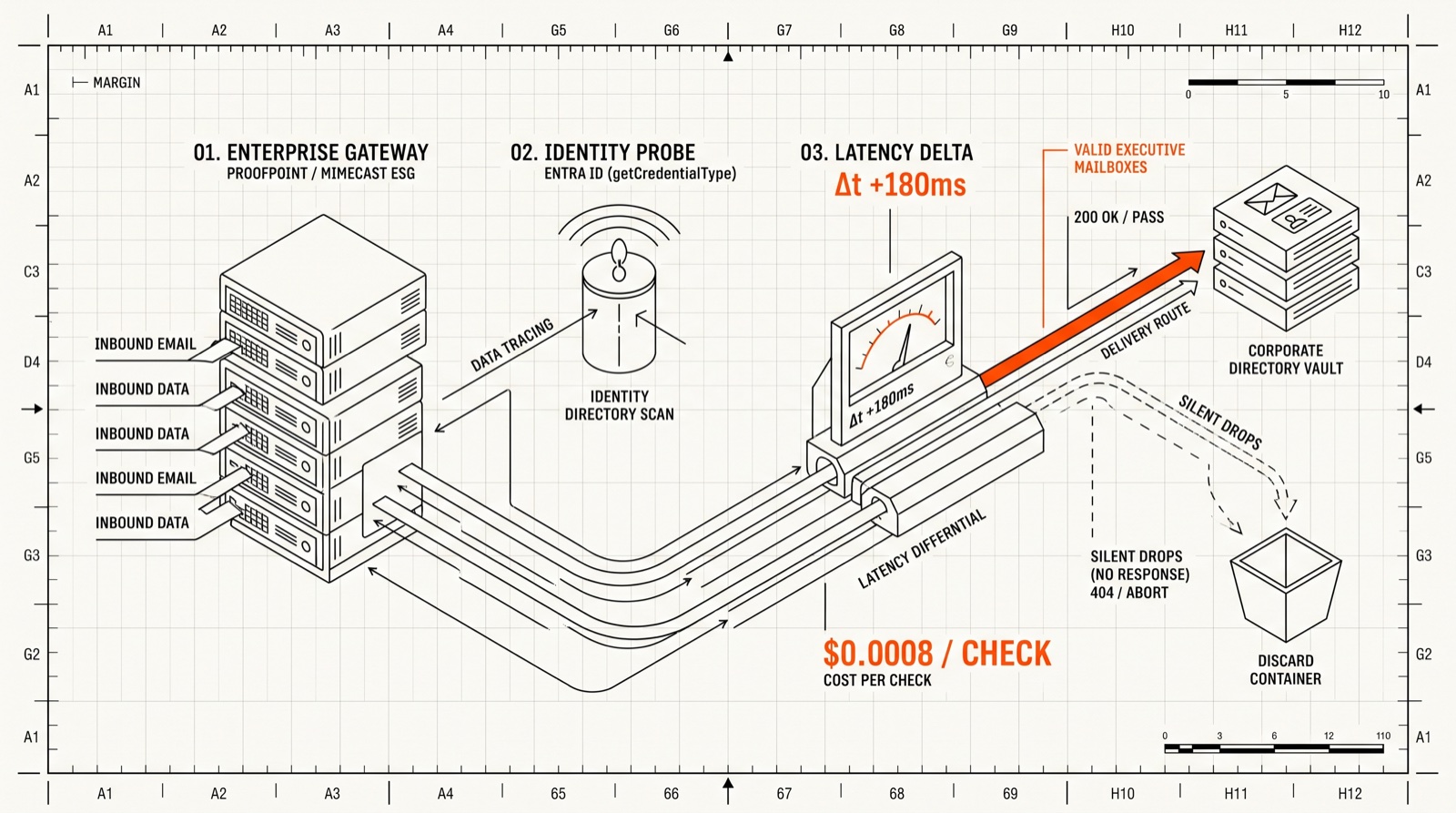
In plain English, Stage 1A executes non-sending Enterprise Identity-Directory Telemetry Probes over standard HTTPS port 443 to confirm whether an executive’s corporate cloud identity is actively provisioned—completely bypassing the company’s port 25 email spam firewall. Even when an enterprise routes inbound MX traffic through Proofpoint or Mimecast in 100% catch-all mode, employees still authenticate into Microsoft 365, Teams, and SharePoint over HTTPS using their primary corporate email as their User Principal Name (UPN). Our telemetry gate classifies managed enterprise directory responses into three deterministic outcomes:
- Active Provisioned Identity Match: Deterministically confirms the target
UPNis provisioned and active inside the organization’s managed cloud identity directory without touching the mail server. - Unprovisioned or Deactivated Identity Suppression: Proves the candidate address does not exist in the managed directory—immediately suppressing invalid permutations. Better yet, when an executive departs a company and IT revokes their master cloud identity while temporarily leaving a mail-forwarding alias open, our identity-directory probe detects the revoked master account and prevents reps from pitching a departed buyer.
- Edge Rate-Governance & Subnet Rotation: Detects upstream directory rate-shaping thresholds in real time and rotates telemetry probes across clean residential ISP subnets at ~0.1x baseline compute.
Stage 1A resolves 35% to 48% (40% benchmark share) of raw B2B candidates in <300ms without sending a single packet to the target’s MX gateway.
Stage 1B & Stage 2: Multi-EHLO SMTP + L42 Dual-Stage ESG Latency Triangulation
Simply put, when an email security firewall claims every address is valid, Stage 2’s Proprietary Catch-All Resolution Gate measures how many milliseconds the firewall pauses to look up the employee internally—because real mailboxes trigger a downstream directory policy check while fake ones do not. Non-ESG domains outside managed cloud directories first pass through Stage 1B’s multi-EHLO SMTP handshake (20% of inputs), while the remaining 25% catch-all and ESG-guarded domains route into L42 Dual-Stage ESG Latency Triangulation alongside federated IdP (Okta / OneLogin) telemetry.
Instead of trusting the static 250 OK banner, Stage 2 compares synchronized RCPT TO sessions from clean residential ASNs. Inline gateways such as Proofpoint Core Email Protection and Mimecast execute live downstream LDAP or Active Directory recipient callouts and load user-level policy profiles only when a real employee mailbox matches. Comparing a guaranteed non-existent synthetic canary address against the target executive isolates a clear positive callout delta (Δt of +120ms to +450ms, averaging +180ms in FIG. 20) for live mailboxes, requiring a combined confidence score of >= 0.92 before marking any catch-all candidate deliverable. Across a 10,000-input benchmark, short-circuiting Stage 0 and Stage 1A before deep timing checks achieves >90% waterfall waste reduction (~0.1x baseline compute, included in our flat monthly tier rate with a $0 client credit tax), recovering 55.2% of valid catch-all executives at a 0.74% cumulative bounce rate.
Why Pre-Verified Batches Beat Maintaining Multi-Vendor Catch-All Waterfalls In-House
Building and maintaining verification ledgers, orchestrating clean residential subnets for Enterprise Identity-Directory Telemetry Probes, calibrating L42 Dual-Stage ESG Latency Triangulation thresholds across Proofpoint and Mimecast gateway updates, and enforcing our Proprietary Catch-All Resolution Gate alongside info@ role-trap filters requires full-time systems engineering. At 42leads, every monthly batch executes live pre-send verification right before CSV or Google Sheet delivery, pairing 100% verbatim public 1–2★ customer complaints and website/ad-funnel conversion gaps with verified Founder, Owner, CEO, Partner & Medical Director work emails:
- Core Pipeline (
150verified US leads/mo): $980/month ($882/mo on 6-month plans; $833/mo on annual). - Scale Pipeline (
300verified US leads/mo · Most Popular): $1,650/month ($1,485/mo on 6-month plans; $1,402/mo on annual). - High-Velocity Pipeline (
500verified US leads/mo): $2,450/month ($2,205/mo on 6-month plans; $2,082/mo on annual).
All 3-month, 6-month (-10%), and 12-month (-15%) commitments carry a $0 setup fee (a one-time $750 setup fee applies only on 1-Month Flex-Test runs), backed by 0% info@ in primary rows, a 90-day territory lock, and a contractual <2% bounce SLA with 1-for-1 replacement.
Catch-All, Identity-Directory & Proofpoint/Mimecast Verification FAQ
UPN) is actively provisioned—or suppresses the record when an employee has departed and IT has revoked their master identity—resolving 35% to 48% of B2B domains in under 300ms at ~0.1x baseline compute without sending a single SMTP packet.
RCPT TO commands for a synthetic non-existent canary alongside a target executive address, inline gateways such as Proofpoint and Mimecast execute downstream LDAP or Active Directory callouts and hydrate user security profiles only for real accounts. Measuring that +120ms to +450ms positive latency differential recovers 55.2% of valid catch-all executives at a 0.74% real-world bounce rate.
Test our non-sending Identity-Directory and ESG latency-verified executive data on your hardest target accounts—get a Free 5-Row Custom Sample ($0, unmasked CSV, zero sales calls).