
ListKit’s 0.1% Reply Reality vs. The 42-Lead Signal Thesis: Why Blasting 30,000 Emails Across 40 Burner Inboxes Is Dead
Inside the unit economics of $597–$2,985/month multi-tenant cold email bundles—why hammering 1,000 shared contacts for 1 positive reply (99.9% deflection) scorches finite B2B markets, and why the top 10% of outbound campaigns average exactly 42 signal-verified leads.
Multi-tenant “Done-For-You” cold email bundles like ListKit ($597 to $2,985/month) place 10,000+ simultaneous subscribers inside the same static 626M–977M contact warehouse, forcing senders to blast 1,000 contacts per 1 positive reply (a 0.1% positive reply rate and 99.9% deflection) across 20 burner domains and 40 rotated inboxes just to generate 30 monthly conversations. Empirical multi-million-campaign telemetry from Lemlist proves the exact opposite mathematical law: while the median B2B campaign blasts 410 leads with only 1.4% signal targeting, the top 10% of B2B campaigns average exactly 42 leads, anchor on a verified buying signal 38% of the time (27x higher signal density), and generate 5x to 6x higher positive reply rates (~41 touches per booked meeting). That empirical 42-lead inflection point—paired with Deep Thought’s famous Answer—is the mathematical foundation behind 42leads’s bounded 150, 300, and 500 monthly signal-verified Owner cohorts.
What Happens When 10,000+ Subscribers Blast the Same Static Database Across 40 Burner Inboxes?
Over the past three years, an entire sub-economy of “brute-force cold email infrastructure” emerged out of high-volume agency coaching communities across Client Ascension, Whop, and Skool. Led by ListKit (founded by Andre Haykal Jr. and his Client Ascension co-founders), the pitch to young B2B agencies sounded seductive: instead of researching individual accounts, rent a turnkey bundle combining bulk database credits with dozens of pre-configured secondary domains and rotated sending mailboxes.
Inspect ListKit’s published Full Stack / Done-For-You Cold Email Setup tiers, and the underlying ballistics model becomes unmistakable. The entry $597/month tier provisions 1,000 cold emails per day (~30,000/month) backed by 10,000 static lead credits, 20 burner domains, and 40 rotated Google/Microsoft inboxes, while high-volume setups scale linearly to $2,985/month for 5,000 emails/day (150,000 cold emails/month across 100 domains and 200 inboxes) and up to $5,970/month at 10,000 emails/day.
Why would any B2B company need forty to two hundred disposable inboxes just to book sales meetings? ListKit’s own published onboarding and reply-rate documentation answers the question candidly: users are instructed to expect roughly 1 positive reply per 1,000 contacts emailed—an admitted 0.1% positive reply rate (and a 99.9% market deflection rate). When 10,000+ simultaneous paying subscribers have already fired more than 100 million cold emails out of the exact same static 626M–977M contact pool using identical coaching templates, every US SaaS Founder, Agency CEO, and eCommerce VP inside that warehouse receives twenty variations of the same Vogon-poetry pitch every week.
Click any US account to contrast 0.1% Shared-Database Spray vs. 42-Lead Signal Precision
Retire the 40-inbox spray cannon. Test 5 unmasked signal-verified US leads in your niche free.
Get Your Free 5-Row Custom Sample →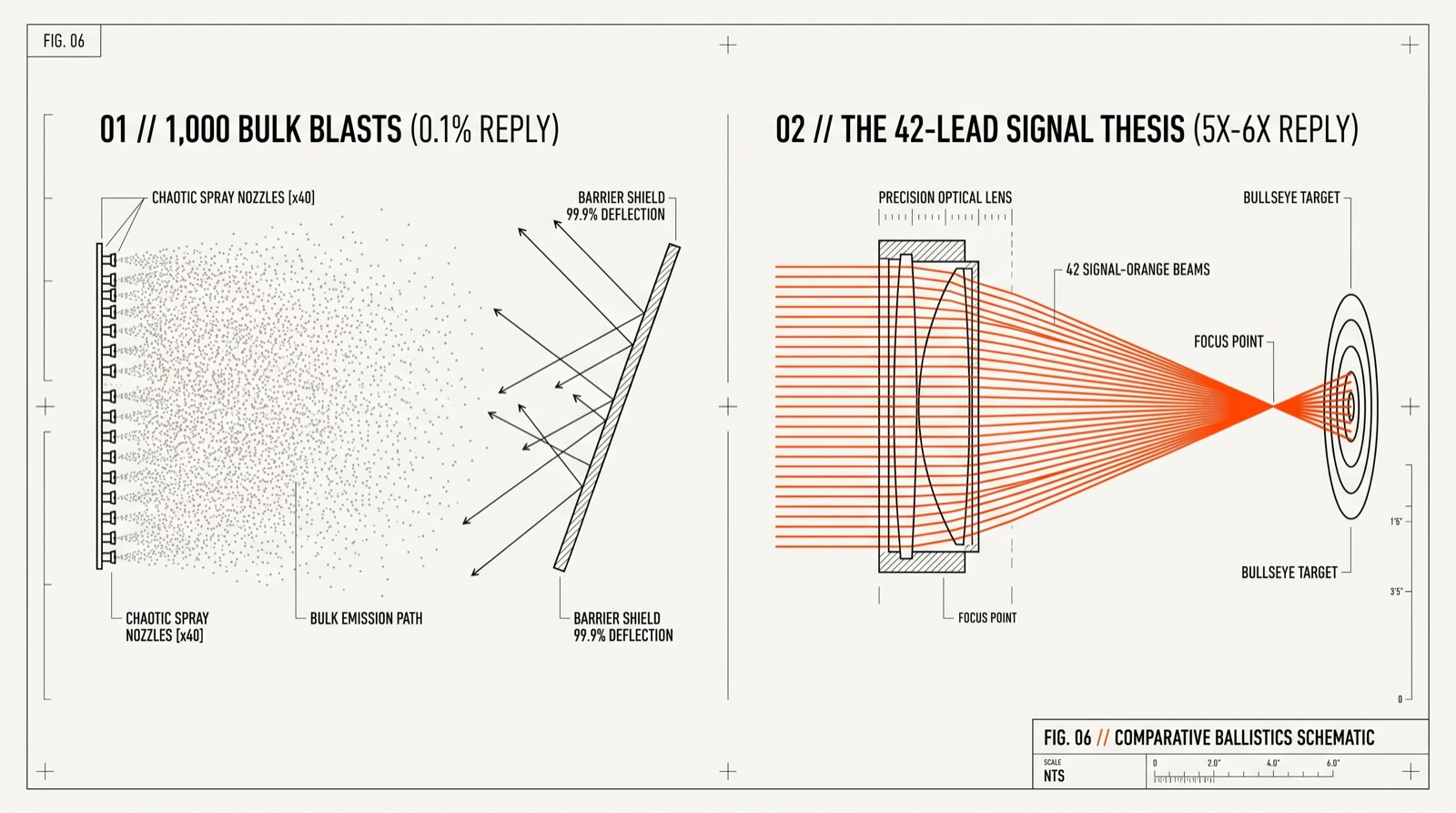
| Economic & Ballistics Metric | ListKit Full Stack / Bulk DFY | Median B2B Campaign (Lemlist Study) | Top 10% Signal Cohort & 42leads |
|---|---|---|---|
| Monthly Package Spend | $597 to $5,970 per mo (+ sequencer & domain renewal churn) | ~$350–$900/mo DIY database + sequencer seats | $980 / $1,650 / $2,450 flat ($882–$2,205/mo on 6M; $0 setup on 3M+) |
| Campaign Cohort Size | 10,000–50,000 static contacts / mo (30,000–150,000 emails blasted/mo) | 410 leads per campaign batch | 42 leads per micro-campaign (150 / 300 / 500 monthly verified leads) |
| Domain & Mailbox Footprint | 20–100 burner domains & 40–200 rotated inboxes continuously replaced | 5–15 secondary inboxes | 2–4 clean authenticated secondary domains (<25 plain-text emails/day) |
| Verified Buying Signal Rate | 0% unstructured operational pain (static firmographic + keyword tags only) | 1.4% of campaigns start from a buying signal | 38% industry top-decile benchmark; 100% on 42leads pain-signal rows |
| Multi-Tenant Pool Contention | 10,000+ simultaneous users hammering the same 626M–977M static pool (0 exclusivity) | Shared Apollo / Lusha / ZoomInfo exports | 90-day vertical territory lock + permanent client deduplication ledger |
| Positive Reply & Meeting Efficiency | 0.1% positive reply (1,000 contacts blasted per 1 positive reply; 99.9% deflection) | 0.5%–1.2% total reply; ~250–400+ touches per booked meeting | 5x–6x positive reply lift (~41 touches per booked meeting in top decile) |
| Verification & Catch-All Hygiene | “Triple-Verified” commodity API + Scrubby blank-email probe (48–72h lag) | Single-pass bulk verifier; 3%–8% catch-all bounce leakage | Two-stage live SMTP handshake; 0% info@ & <2% bounce SLA (1:1 replace) |
Why Does “Triple-Verified” Spray-and-Pray Destroy Finite B2B Total Addressable Markets?
To reassure buyers worried about inbox placement, bulk database platforms heavily market proprietary-sounding terms like “Triple-Verified Leads.” Under the hood, that pipeline performs three commodity steps: (1) pulling a cached contact record from a shared B2B warehouse, (2) running a standard syntax and MX check via MillionVerifier or NeverBounce, and (3) routing catch-all domains through a blank-probe service like Scrubby.io, which dispatches sacrificial test emails and waits 48 to 72 hours for delayed bounce-backs. Not only does blank-email probing trip modern enterprise security gateways (Proofpoint, Mimecast, and Microsoft Defender) before your actual pitch arrives, it solves zero percent of the real outbound crisis: message-to-market irrelevance.
Do the arithmetic on finite Total Addressable Market (TAM) exhaustion. Suppose your vertical SaaS or B2B agency sells into multi-location US orthodontic groups, 30-truck commercial HVAC contractors, or Series A logistics software companies. Most specialized B2B niches contain between 3,500 and 12,000 qualified accounts nationwide—not ten million. If you run ListKit’s entry 30,000-email/month setup (or worse, the $2,985/month 150,000-email cannon) at a 0.1% positive reply rate, you burn through your entire nationwide addressable market in 60 to 90 days while permanently associating your brand—even behind 301-redirected lookalike domains—with uncontextualized spam. Meanwhile, Google Workspace and Microsoft 365 now aggregate sender fingerprints at the template, redirect-target, and ASN cluster level, enforcing strict 0.1% to 0.3% spam-complaint ceilings that neutralize 40-inbox rotation farms en masse.
What Did Lemlist’s Multi-Million-Campaign Dataset Prove About the Number 42?
Look past cherry-picked social media screenshots and inspect actual sequence performance across millions of B2B cold emails, and a clear power law emerges. In Lemlist’s landmark empirical study comparing median outbound campaigns against top-decile (top 10%) performers across millions of dispatched messages, three numbers separated stagnant SDR teams from compounding pipeline engines:
- 410 vs. 42 Leads Per Campaign: While the median B2B campaign blasted 410 leads in a single generic drop, the top 10% of B2B campaigns averaged exactly 42 leads per campaign—nearly ten times smaller and tightly segmented around a single operational bottleneck.
- 1.4% vs. 38% Buying-Signal Density (27x Lift): Only 1.4% of median B2B campaigns anchored outreach on a concrete buying trigger. By contrast, top-decile 42-lead campaigns started from a verified operational or commercial signal 38% of the time—a 27x increase in signal density.
- 5x to 6x Higher Positive Reply Rates (~41 Touches Per Meeting): Micro-cohort signal campaigns generated 5x to 6x higher positive reply rates than 1,000-contact static blasts, booking qualified sales meetings every ~41 touches instead of torching 1,000+ decision-makers to scrape out a single conversation.
Why 42leads Is Engineered Around Surgical 42-Lead Signal Cohorts
Readers of Douglas Adams’ The Hitchhiker’s Guide to the Galaxy know that Deep Thought spent 7.5 million years computing 42 as the Answer to the Ultimate Question of Life, the Universe, and Everything. In modern B2B outbound, Lemlist’s telemetry proved that 42 is also the exact empirical size of a top-10% signal-led micro-campaign.
Instead of selling you 10,000 over-farmed commodity credits and telling you to manage forty burner mailboxes, 42leads delivers calm, surgical monthly or bi-weekly batches of US accounts where 100% of primary rows carry character-verified public 1–2★ customer complaints or website/ad-funnel conversion gaps paired with SMTP-verified Founder, Owner, CEO, Partner, or Medical Director work emails (0% info@, <2% bounce SLA with 1-for-1 replacement, and a 90-day territory lock):
- Core Pipeline (
150verified US leads/mo ≈ 3.5 surgical 42-lead cohorts): $980/month standard (-10%on 6M;-15%on 12M). - Scale Pipeline (
300verified US leads/mo ≈ 7 surgical 42-lead cohorts · Most Popular): $1,650/month standard (-10%on 6M;-15%on 12M). - High-Velocity (
500verified US leads/mo ≈ 12 surgical 42-lead cohorts): $2,450/month standard (-10%on 6M;-15%on 12M).
All 3-month, 6-month, and 12-month plans include a $0 USD setup fee ($750 one-time setup applies only on a 1-Month Flex-Test). Put the 42-Lead Signal Thesis to an immediate A/B test against your current cold email stack: request your Free 5-Row Custom Sample ($0, unmasked CSV delivered straight to your inbox, zero sales calls) and measure what happens when every email opens with verified operational proof.
Bulk Cold Email vs. The 42-Lead Signal Thesis FAQ
info@ primary rows, a <2% bounce SLA, and a 90-day territory lock.
Retire the 40-inbox burner farm—A/B test 5 unmasked US Owner + verbatim pain-signal leads in your niche free.