
Why Internal n8n and Playwright Scrapers Return 403s in 2026: A Protocol-Level Teardown of JA4, CDP Leaks, and LinkedIn BrowserGate
Inside the six-layer perimeter defense stack breaking DIY low-code workflows—and why maintaining an internal stealth scraping cluster quietly burns $196,000/year in engineering and residential proxy overhead.
DIY scrapers built on cloud-hosted n8n nodes, Python requests, or vanilla Playwright fail against protected B2B sites in 2026—and maintaining an internal stealth stack costs $196,000/year ($36,000/year in residential proxy bandwidth plus a $160,000/year anti-bot systems engineer) while cloud LinkedIn cookie-bridge tools actively trigger executive account restrictions. Cloudflare now classifies 15 million+ daily JA4 TLS fingerprints with 98.63% ML accuracy and checks Post-Quantum ML-KEM key shares, Turnstile detects Playwright’s Runtime.enable protocol in five lines of JavaScript, and LinkedIn’s BrowserGate probes 6,222 Chrome extensions plus 48 hardware signals. Reliable public signal extraction requires a Three-Tier Escalation Stack (L42 Transport-Layer Impersonation, Compile-Time Patched Stealth Drivers, and Proprietary C++ Rendering Binaries)—delivered without infrastructure overhead via flat monthly batches ($980 to $2,450/month).
Why Do Cloud-Hosted n8n HTTP Nodes and Python Scrapers Fail Before Sending a Single Byte of HTML?
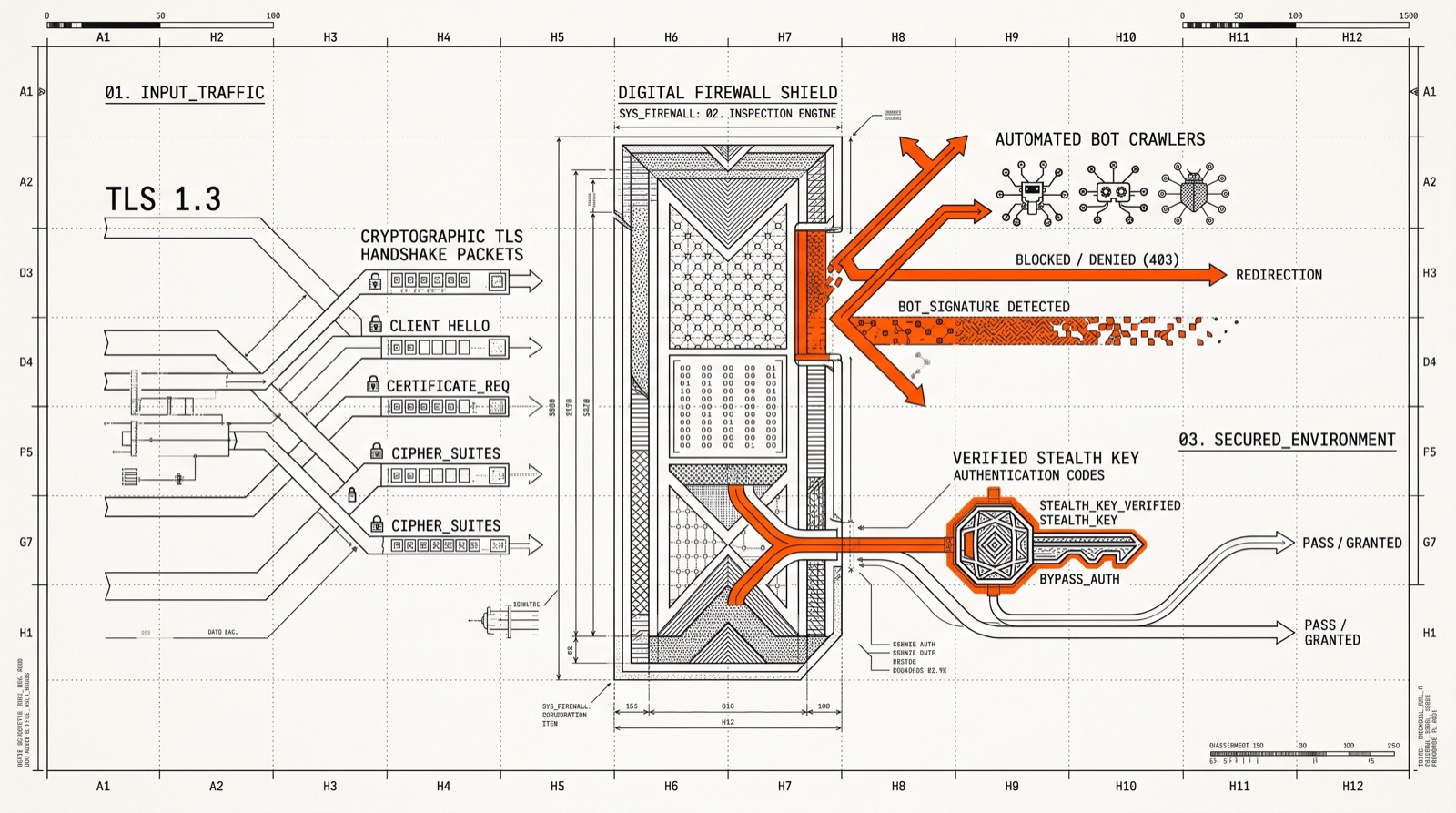
Cloud-hosted n8n HTTP Request nodes, Make.com webhooks, and Python requests or httpx scripts are rejected before an HTTP header is ever decrypted because perimeter firewalls classify traffic at the Autonomous System Number (ASN) and Transport Layer Security (TLS) handshake layers. When a workflow worker runs on AWS, GCP, Hetzner, or DigitalOcean, Cloudflare Enterprise Bot Management, DataDome, and HUMAN Security flag the commercial datacenter ASN immediately, returning an HTTP 403 Forbidden or forcing an expensive proof-of-work loop.
Even when an internal RevOps engineer routes n8n or Python traffic through a clean residential proxy, edge security inspects the raw TLS ClientHello packet. Earlier JA3 hashes became unreliable once Chrome began randomizing TLS extension order on every connection. In response, perimeter networks standardized on JA4 fingerprinting—a deterministic multi-part signature that records protocol type, TLS version, SNI presence, cipher and extension counts (ignoring GREASE dummy values), ALPN negotiation, and lexicographically sorted cipher and extension hashes.
Comparing a stock Python or Node.js OpenSSL request against a genuine browser across TLS handshake inspection endpoints exposes three immediate fatal mismatches:
- 98.63% JA4 Machine Learning Isolation: Cloudflare processes over 15 million unique JA4 fingerprints daily inside its ML Bot Score v9 engine (scoring
1for confirmed automation,2–29for likely bots, and30+for human browsers). OpenSSL cipher suites diverge starkly from Google’s BoringSSL, allowing classifiers to isolate standard HTTP libraries with 98.63% accuracy. - Post-Quantum ML-KEM Key-Share Checks: Desktop Chrome builds from version 124 onward negotiate Post-Quantum hybrid key exchange (
ML-KEM) inside theClientHello. Legacy TLS-spoofing wrappers pinned to older browser profiles lacking Post-Quantum key shares are flagged instantaneously. - HTTP/2 Frame Sequencing: Immediately beneath TLS, edge proxies inspect HTTP/2
SETTINGS,WINDOW_UPDATE, and pseudo-header ordering (:method,:authority,:scheme,:path). Genuine Chrome profiles emit exact window capacities and frame sequences, whereas generic Node.js and Go HTTP/2 clients send default window sizes that contradict their spoofed User-Agent.
Inspect clean, challenge-free US B2B payloads extracted without 403 poisoning
Want 5 live, unmasked signal leads in your exact vertical?
Request Your Free 5-Lead Sample Batch →How Do Cloudflare Turnstile and DataDome Detect Vanilla Playwright via CDP Runtime.enable in Five Lines of JavaScript?
Whenever a target directory requires JavaScript execution or serves Cloudflare’s /cdn-cgi/challenge-platform/scripts/jsd/main.js and Turnstile harness, vanilla Playwright, Puppeteer, and Selenium fail immediately because of Chrome DevTools Protocol (CDP) serialization leaks. To track frame lifecycles and evaluate DOM selectors, stock automation drivers automatically dispatch Runtime.enable and Console.enable CDP commands upon tab attachment.
Anti-bot scripts detect an active Runtime.enable session in five lines of JavaScript: they pass an Error object with a custom property getter to console.debug(). In a normal human Chrome tab with DevTools closed, Chromium never serializes the console argument and the getter never fires. When Playwright has enabled the Runtime domain, Chromium serializes the object to emit Runtime.consoleAPICalled, firing the trap getter and exposing the automation driver even over a clean residential IP.
Worse yet, legacy Generation-1 stealth wrappers like puppeteer-extra-plugin-stealth and playwright-stealth now actively accelerate detection. Overwriting browser globals via Page.addInitScript mutates prototype chains and triggers nativeTampering and Web Worker mismatch flags (workerConsistency), while Linux Docker containers without physical GPUs leak software rasterizers like Google SwiftShader or Mesa OffScreen during WebGL and Canvas pixel hashing. DataDome even attaches a MutationObserver to detect DOM globals injected by AI browser frameworks (such as __playwright_builtins__ or agent highlight attributes). Meanwhile, naive scrapers checking only status_code == 200 fall victim to silent data poisoning: Cloudflare challenge pages frequently return an HTTP 200 OK containing a 46,480-byte challenge shell with zero business data, and retrying those requests trains Cloudflare’s ML classifier to ban the fingerprint permanently.
What Is LinkedIn’s BrowserGate (chunk.905), and Why Do Cloud Cookie-Bridge Tools Trigger Account Restrictions?
Client-side anti-bot escalation reached a watershed moment with LinkedIn’s BrowserGate architecture, documented by Fairlinked e.V. in early 2026. Whenever any Chromium-based browser loads LinkedIn, the platform ships a ~2.7 MB Ember.js bundle containing Webpack chunk.905 (internal module 75023). Gated behind isUserAgentChrome(), BrowserGate executes a three-stage surveillance dragnet alongside HUMAN Security and Google reCAPTCHA Enterprise:
- Stage 1 — Active Extension Detection (AED): BrowserGate iterates through a hardcoded catalog of 6,222 Chrome extensions (growing by ~12 extensions per day, including 762 LinkedIn automation tools and 209 B2B sales extensions), probing declared
web_accessible_resourcessequentially during idle browser CPU cycles so network spikes stay hidden in DevTools. - Stage 2 — DOM Spectroscopy: A recursive DOM walker inspects every HTML attribute and text node from the document root for the substring
chrome-extension://, extracting the 32-character ID of any unlisted CRM overlay or AI scraper modifying the page. - Stage 3 — APFC 48-Signal Encrypted Telemetry: Extension hits are merged with 48 hardware and environment signals—CPU cores, RAM, WebGL renderer, AudioContext float variance, font metrics, WebRTC local IPs, and automation flags—encrypted client-side, and posted to
/li/track.
Security audits of six popular “cookie-bridge” LinkedIn cloud tools showed that five out of six replayed exported li_at and JSESSIONID cookies from datacenter ASNs while stripping or mismatching the 48-signal APFC device fingerprint—resulting in rapid executive account restrictions. Proprietary C++ Rendering Binaries built on non-Chromium engines remain architecturally immune to chrome-extension:// AED probes because non-Chromium builds fail the isUserAgentChrome() check and block web-page extension fetches natively.
| Defense Layer | Active Telemetry Probe | Why DIY n8n / Vanilla Playwright Fails | 2026 Production Countermeasure |
|---|---|---|---|
| 1. Network & ASN | Datacenter ASN blacklists & IP fraud scores | AWS, GCP, Hetzner & DigitalOcean workers get instant HTTP 403 at edge | Sticky residential & 4G/5G mobile proxy pools with ZIP rotation |
| 2. TLS Handshake (JA4) | 15M+ daily JA4 hashes + Post-Quantum ML-KEM |
Python/Node OpenSSL stacks isolated as bots with 98.63% ML accuracy | L42 Transport-Layer Impersonation pinned to Chrome 124–146 BoringSSL |
| 3. HTTP/2 Framing | SETTINGS, WINDOW_UPDATE & pseudo-headers |
Generic window capacities contradict spoofed desktop User-Agent strings | Byte-exact replay of native Chrome HTTP/2 frame sequence |
| 4. CDP Driver Protocol | 5-line JS console getter probing Runtime.enable |
Stock Playwright/Puppeteer enables Runtime on attach, tripping Turnstile |
Compile-Time Patched Stealth Drivers in isolated worlds (no Runtime.enable) |
| 5. Engine & Extensions | WebGL SwiftShader check + BrowserGate 6,222 AED probes | playwright-stealth trips nativeTampering; Linux leaks software GPU |
Proprietary C++ Rendering Binaries + zero Chromium extension footprint |
| 6. Behavioral Physics | Cursor trajectories, scroll inertia & inter-arrival ML | Instant DOM clicks & fixed sleep timers drop Bot Score below 30 |
C++ Bézier micro-jitter cursor physics & gamma-distributed request pacing |
| Infrastructure & Labor Component | In-House Scraper Build (Annual TCO) | 42leads Managed Signal Batches |
|---|---|---|
| Senior Anti-Bot & Systems Engineer (1 FTE) | $160,000 / year (C++ binary rebuilds, DOM selector maintenance, QA) | $0 internal headcount (100% amortized engineering) |
| Residential & Mobile Proxy Bandwidth | $36,000 / year ($3,000/mo @ $6/GB; full browser loads burn 2–8 MB/page = 3x HTTP cost) | Included ($0 proxy or solver micro-charges) |
| Total Annual Outlay | $196,000 / year (+ silent 200-OK challenge poisoning risk) | $11,760 – $29,400 / yr ($980–$2,450/mo standard; -15% on 12M · $0 Setup on 3M+) |
What Is the True Annual Total Cost of Ownership of Maintaining Internal Stealth Scrapers?
When Founders and VPs of RevOps budget for internal web extraction, they typically price a $50/month VPS for n8n while overlooking two massive recurring costs: bidirectional residential proxy bandwidth and continuous C++ browser maintenance. In 2026, top-tier residential proxy pools command $2.50/GB to $8.00/GB ($6.00–$8.00/GB on entry tiers), and mobile proxies run $3.50/GB to $7.50/GB. Because unoptimized headless browsers download 2 MB to 8 MB of JavaScript bundles, fonts, and media per page—costing 3x more per request than an L42 Transport-Layer Impersonation request—proxy bills quickly hit $3,000/month ($36,000/year).
Pair that bandwidth burn with a single $160,000/year scraping systems engineer tasked with recompiling Compile-Time Patched Stealth Drivers and Proprietary C++ Rendering Binaries on every browser release, writing payload assertions against 46,480-byte challenge shells, and repairing directory XPath selectors, and an internal stack consumes $196,000 annually before booking a single sales meeting.
42leads eliminates this entire $196,000/year infrastructure tax by amortizing German-architected, Singapore-operated extraction pipelines across curated US B2B batches (and if your engineering team requires a bespoke turnkey n8n/PostgreSQL extraction pipeline built to spec, we scope custom builds on request). Every monthly package delivers verified US pain-signal and active Founder/Owner leads with 0% info@, a 90-day territory lock, and a strict <2% bounce SLA (1-for-1 replacement):
- Core Pipeline (
150verified US leads/mo): $980/month standard (-10%on 6M;-15%on 12M). - Scale Pipeline (
300verified US leads/mo · Most Popular): $1,650/month standard (-10%on 6M;-15%on 12M). - High-Velocity (
500verified US leads/mo): $2,450/month standard (-10%on 6M;-15%on 12M).
All 3-month, 6-month, and 12-month commitments include $0 USD setup ($750 setup applies only on a 1-Month Flex-Test). Skip debugging HTTP 403s and test our output risk-free: request a Free 5-Row Custom Sample ($0, unmasked CSV, zero sales calls) calibrated to your exact US niche.
JA4, CDP Detection & Anti-Bot Architecture FAQ
puppeteer-extra-plugin-stealth and playwright-stealth overwrite navigator properties at runtime via Page.addInitScript. Modern anti-bot scripts easily flag broken prototype chains, altered Function.prototype.toString outputs, and mismatches between the main thread and Web Workers, while the underlying CDP Runtime.enable leak remains completely exposed.
ClientHello packet before decrypting HTTP headers, classifying non-browser JA4 hashes and missing Post-Quantum ML-KEM key shares as automated traffic with 98.63% accuracy.
li_at session cookies into third-party cloud scrapers exposes executive LinkedIn accounts to BrowserGate and APFC device-fingerprint mismatches. 42leads operates strictly on public corporate web records, customer reviews, statutory filings, and live SMTP verification—requiring zero client credentials, zero browser extensions, and zero proxy subscriptions.
Stop debugging HTTP 403s and proxy pools—test 5 unmasked US Owner + verbatim pain-signal leads in your niche free.