
Beyond Generic Role Inboxes in Europe: Automated § 5 DDG Impressum & Commercial Register Extraction for DACH Outbound
Why US-built contact brokers suffer 15%–35% hard bounces across Germany, Austria, and Switzerland—and how statutory /impressum parsing under § 5 DDG deterministically resolves the legal Geschäftsführer, HRB number, and USt-IdNr.
US contact databases like Apollo, ZoomInfo, and Lusha suffer 15% to 35% hard bounce rates across Germany, Austria, and Switzerland because Mittelstand managing directors rarely maintain LinkedIn profiles—leaving outbound teams stuck with generic info@ or zentrale@ role inboxes and broken umlaut email guesses. Under Germany's Digitale-Dienste-Gesetz (§ 5 DDG), Austria's § 5 ECG, and Switzerland's ZEFIX registry, every commercial website must legally publish its authorized Geschäftsführer or Vorstand, commercial register number, and VAT ID within two clicks. Automated statutory extraction resolves 90% to 95%+ of DACH decision-makers with zero AI hallucination while flagging obsolete § 5 TMG citations and dead EU Online Dispute Resolution (OS) links as ready-to-use compliance hooks.
Why Do US B2B Databases Suffer 15% to 35% Hard Bounce Rates Across Germany, Austria, and Switzerland?
Revenue leaders expanding a North American outbound motion into the DACH region (Germany, Austria, and Switzerland) routinely watch sender domain reputations collapse within ten days of launching sequences from US sales-intelligence exports. Independent deliverability audits across European and Central Eastern European cohorts document 15% to 35% real-world hard bounce rates on supposedly verified database contacts—with controlled 250-lead benchmarks recording up to 42% bounce rates on non-US rows.
Three structural mismatches break US databases in Europe. First, the German Mittelstand—precision engineering firms, industrial OEMs, regional logistics groups, and specialized B2B agencies—operates largely off LinkedIn; where a US SaaS VP updates LinkedIn weekly, a German Geschäftsführer either has no profile or maintains an dormant XING stub. Second, strict GDPR Article 14 notice obligations restrict multi-tenant US data brokers from harvesting contributor address books across EU jurisdictions, causing cached European records to rot past 24 months. Third, English-only pattern guessers mishandle German diacritics (ä, ö, ü, ß) and academic titles (Dr.-Ing., Dipl.-Kfm.)—naively synthesizing m.krueger@ as m.kruger@ or including honorific prefixes inside the RFC 5321 local-part.
Even worse, falling back to generic info@ or kontakt@ role inboxes creates severe legal friction under § 7 Abs. 2 Nr. 2 of the German Unfair Competition Act (Gesetz gegen den unlauteren Wettbewerb, UWG). Because B2B cold outreach in Germany relies on presumed consent (mutmaßliche Einwilligung) anchored in strict concrete relevance to the recipient's corporate remit, blasting generic switchboard inboxes irritates administrative staff and elevates cease-and-desist (Abmahnung) exposure.
/impressum still cites repealed § 5 TMG; active Google Search ads drive B2B buyers to a static RFQ form with zero STEP/CAD file upload widget.
Footer links to defunct EU ec.europa.eu/consumers/odr portal (shut down July 20, 2025) + B2B reorder traffic lands on unindexed 48-page PDF catalog.
2★ Industry Portal Review: “Calibration RMA tickets still require faxing or emailing a PDF form—waited nine days for return authorization.”
Want 5 live, unmasked signal leads in your exact vertical?
Request Your Free 5-Lead Sample Batch →How Does Statutory § 5 DDG Impressum Parsing Resolve Every DACH Managing Director Without LinkedIn?
While strict European privacy rules handicap US crowdsourced databases, German, Austrian, and Swiss corporate transparency statutes hand deterministic data engineers an extraordinary structural advantage. On May 14, 2024, Germany enacted the Digitale-Dienste-Gesetz (DDG), formally repealing the legacy Telemediengesetz (TMG) to harmonize German national law with the European Digital Services Act (DSA).
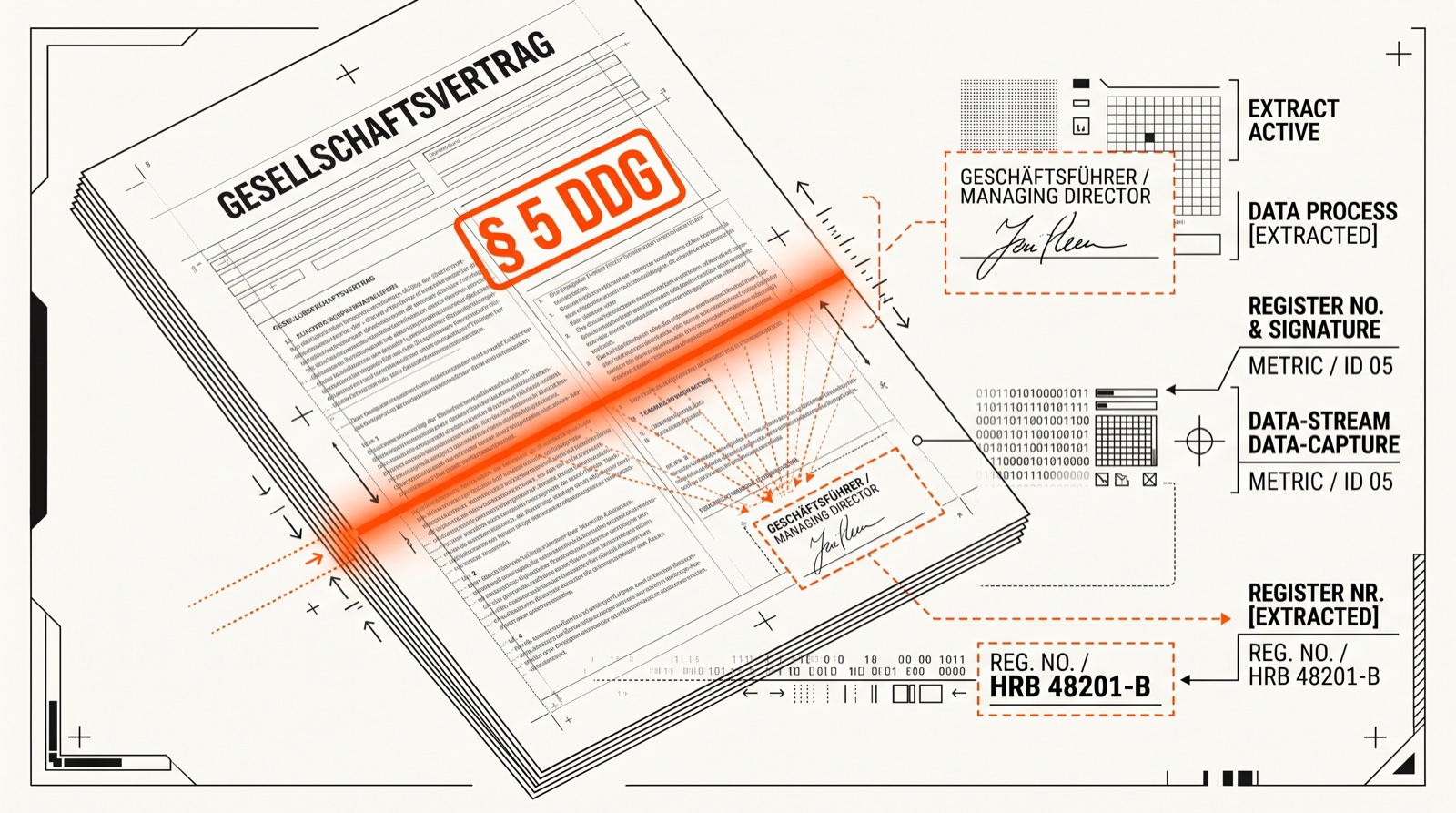
Under § 5 Abs. 1 Nr. 1–7 DDG (alongside parallel statutory mandates in Austria under § 5 ECG / § 25 MedienG and in Switzerland under Art. 3 Abs. 1 lit. s UWG), every commercial digital service provider (geschäftsmäßige digitale Dienste) is legally required to maintain an easily recognizable, directly accessible corporate imprint (/impressum, /rechtliches, or /kontakt) reachable within two clicks from any landing page. Unlike US “About Us” marketing blurbs, a German /impressum carries strict statutory liability if incomplete, requiring explicit disclosure of:
- Legal Corporate Name & Form: Exact entity suffix (
GmbH,GmbH & Co. KG,AG,SE, orUG (haftungsbeschränkt)). - Summons-Capable Physical Street Address: Full operating street address (ladungsfähige Anschrift—a P.O. box is legally invalid).
- Authorized Legal Representative: Named Managing Director or Executive Board member (Vertretungsberechtigter Geschäftsführer or Vorstand).
- Commercial Register Court & Number: Municipal court (Registergericht) plus register identifier (
HRBorHRA). - VAT Identification Number: Statutory USt-IdNr. pursuant to § 27a UStG.
Extending this statutory architecture across the full DACH economic region requires normalizing three distinct national registry schemas inside one unified parser. Whereas German corporations disclose a decentralized municipal register court (such as Amtsgericht München or Amtsgericht Stuttgart) paired with an HRB or HRA identifier and a DE VAT string, Austrian companies operating under § 5 ECG and § 25 MedienG publish a centralized federal Firmenbuchnummer (FN, e.g., FN 418290k at Handelsgericht Wien), mandatory Wirtschaftskammer (WKO) chamber membership, and an ATU VAT identifier. Swiss enterprises governed by Art. 3 Abs. 1 lit. s UWG resolve against the federal ZEFIX index via a standardized Unternehmens-Identifikationsnummer (CHE-xxx.xxx.xxx) and cantonal Handelsregisteramt filings, exposing authorized signatories (Einzelunterschrift vs. Kollektivunterschrift zu zweien).
Why Do Obsolete § 5 TMG Citations and July 20, 2025 OS Links Serve as High-Intent Compliance Triggers?
Crawling the raw /impressum DOM unlocks more than executive identity—it surfaces immediate regulatory hygiene triggers for legal-tech, e-commerce, web-compliance, and digital-agency offers. Specifically, thousands of German B2B and hybrid B2C portals still display “Angaben gemäß § 5 TMG” years after the May 14, 2024 DDG transition. Even more acutely, on July 20, 2025, the European Union permanently decommissioned the Online Dispute Resolution (OS) platform (ec.europa.eu/consumers/odr) under Regulation (EU) 2024/3228. Maintaining an active hyperlink to the dead EU OS portal in an Impressum or AGB footer constitutes a documented competition-law vulnerability—giving compliance and web-modernization agencies an objective, verifiable diagnostic hook.
| Data Architecture | Mittelstand TAM Coverage | Geschäftsführer Resolution | Umlaut & GmbH & Co. KG Logic | DACH Hard Bounce Rate |
|---|---|---|---|---|
| US Databases (Apollo / Lusha / ZoomInfo) | 10% – 20% (LinkedIn-skewed) | ~15% – 25% | Corrupts ä/ö/ü/ß; fails nested KG structures | 15.0% – 35.0% (Up to 42%) |
| Offshore VA Manual Copy-Paste | Manual (~9.0 min / record) | Moderate (Prone to typos) | 3%–7% UTF-8 encoding & column errors | 10.0% – 18.0% (Catch-all blind) |
| Generic EU Directory Scrapers | 80% – 90% (Domain level) | 0% (Returns info@ / zentrale@) | Dumps role inboxes violating UWG role relevance | 12.0% – 28.0% |
| 42leads § 5 DDG + HRB Pipeline | 92% – 98% (2-Click Statutory) | 90% – 95%+ Verified GF | RFC transliteration + Komplementär-GmbH HRB | <2.0% SLA (1:1 Replace · 0% info@) |
How Do Deterministic Guardrails Solve Nested GmbH & Co. KG Entities and Prevent AI Hallucinations?
Off-the-shelf US scraping templates routinely break on two quintessential German edge cases: nested partnerships and obfuscated imprints. Across German manufacturing and wholesale, thousands of family-owned enterprises operate as a GmbH & Co. KG—a limited partnership registered under HRA whose sole general partner with signing power is a separate management corporation (the Komplementär-GmbH or Verwaltungs-GmbH) registered under HRB. Naive LLM prompts extract the corporate name of the Verwaltungs-GmbH as if it were a person, or hallucinate a plausible German executive name when an imprint renders inside an obfuscated JavaScript modal.
Our multi-gate pipeline eliminates both errors deterministically. First, structured entity parsing inspects both the HRA partnership block and the nested persönlich haftende Gesellschafterin (HRB) block to isolate the natural-person Geschäftsführer, stripping academic honorifics (Prof., Dr. rer. nat., Dipl.-Wirtsch.-Ing.) into structured salutation columns so German formal address (“Sehr geehrter Herr Dr. Baumgartner”) remains flawless while email permutation tests clean transliterated ASCII strings (ä→ae, ö→oe, ü→ue, ß→ss). Second, our Verbatim Substring Gate checks that every extracted Geschäftsführer name and HRB identifier appears character-for-character inside the captured original Impressum text—enforcing a strict 0% hallucination tolerance.
Finally, resolving the statutory officer is only half the deliverability equation across DACH infrastructure. German and Swiss industrial domains heavily deploy enterprise perimeter gateways—such as Hornetsecurity, Retarus, SEPPmail, and hardened Microsoft 365 DE accept-all configurations—that return a blanket 250 2.1.5 OK handshake to every standard SMTP check before silently dropping non-existent local-parts or issuing delayed NDR bounces hours later. Pairing clean DIN 5007-2 umlaut transliteration (ae/oe/ue/ss) with two-stage catch-all verification ensures every delivered Geschäftsführer mailbox is actively routable prior to campaign launch.
What Does This Mean for US Teams Sourcing Through 42leads?
This briefing documents our research on DACH public registers; 42leads production batches cover US businesses only. For US markets the same statutory-first method applies. Instead of locking into $25,000/year enterprise database contracts that bounce at 20%+ on domains they cover poorly, B2B teams source registry-verified US decision-makers on demand through 42leads. Monthly packages scale cleanly across Core Pipeline (150 verified leads/mo at $980/mo), Scale Pipeline (300 verified leads/mo at $1,650/mo · Most Popular), and High-Velocity (500 verified leads/mo at $2,450/mo, with custom enterprise volumes scoped on request)—all with $0 USD setup on 3-month, 6-month (-10%), and 12-month (-15%) plans ($750 setup only on a 1-Month Flex-Test), 0% info@, GDPR Art. 6(1)(f) DPA coverage, and a contractual <2% bounce SLA with 1-for-1 replacement.
DACH § 5 DDG Impressum & HRB Outbound FAQ
ä, ö, ü, ß vs. ae, oe, ue, ss), generating 15%–35% hard bounces.
GmbH & Co. KG limited partnership, the general partner with signing authority is a separate corporation (the Komplementär-GmbH) registered under its own HRB number alongside the partnership’s HRA number. Our parser extracts both the HRA and Komplementär-GmbH HRB blocks from the /impressum and commercial register to isolate the natural-person Geschäftsführer.
42leads delivers US B2B batches only. Start with a Free 5-Row Custom Sample for your US niche ($0, unmasked CSV, zero sales calls).