
Google Customer Match & Meta Custom Audiences for B2B in 2026: Surviving the $50,000 Spend Gate and SHA-256 Hashing Traps
Why uploading raw corporate emails fails to clear 100-member serving floors, how Google's $50,000 Enhanced Access threshold and April 2026 Data Manager API rules reshape Micro-ABM, and why sharing one SHA-256 script silently breaks Meta matches.
Upload a raw list of 300 B2B work emails straight into Meta Ads Manager or Google Ads and your campaign will stall in “Audience Too Small”: corporate emails match fewer than 20% of Meta profiles and 2% to 30% of signed-in Google accounts. At the same time, Google gates Customer Match Targeting mode behind $50,000 USD in lifetime spend plus 90 days of history, enforces a 540-day membership cap, and requires the Google Data Manager API for new automated syncs after April 1, 2026. Reaching 60%–99% Micro-ABM match rates requires multi-key executive columns paired with platform-specific SHA-256 normalization—keeping leading + E.164 prefixes and stripping Gmail dots for Google, while stripping + signs and keeping Gmail dots intact for Meta.
Why Do Raw B2B Work Emails Match Under 20% on Meta and Collapse Micro-ABM Air Cover?
Surrounding a monthly cohort of 150 to 500 signal-verified decision-makers with 7 to 14 days of paid social “air cover” prior to Day-1 outbound email fundamentally transforms acquisition economics. Across 2026 B2B campaign benchmarks, pre-warming outbound cohorts lifts cold email reply rates by 25% to 40% (pushing multichannel reply rates from 1.8% to 4.3%, a 138.9% relative increase), compresses sales cycles from three months to six weeks, and drops blended Cost Per Qualified Meeting from $227.27 (standalone LinkedIn Lead Gen Ads) and $82.22 (standalone cold email) down to $25.00.
Yet when a growth marketer exports 300 corporate emails (founder@company.com) and uploads that CSV directly into Meta Custom Audiences (which offers an unbeatable $7.00 to $9.00 CPM and a 100-user minimum serving floor), the ad set stalls in “Audience Too Small” status. B2B executives do not register personal Facebook, Instagram, or YouTube accounts with corporate domains—and if the seed list contains generic info@ or sales@ role inboxes, match rates hit 0%. Raw corporate emails match under 20% on Meta (500 rows routinely resolve fewer than 90 profiles) and hit a ~2% floor to ~30% ceiling on Google Customer Match.
Clearing Meta's 100-user floor on a lean 150–500 account batch starts with 0% info@ named executive records (standardized first name, last name, city, state, ZIP, and country) enriched via person-level identity graphs into Meta's 3-column email array (email_1 corporate + email_2/email_3 personal) plus phone—lifting match rates to 60%–75%+ (and up to 99% with full multi-key graph resolution).
fn/ln SHA-256email_3 cell skipped (blocks blank-string hash)+1216519****)1216519****)Want 5 live, unmasked signal leads in your exact vertical?
Request Your Free 5-Lead Sample Batch →How Do Google's $50,000 Spend Gate, 540-Day Cap, and April 2026 Data Manager API Rule Work?
Google Customer Match requires a minimum of 100 active signed-in users in Search (with Google recommending 1,000 to 5,000 uploaded rows to buffer match attrition), yet it remains the most frequently misconfigured channel in B2B Micro-ABM due to three hard platform gates enforced across 2025 and 2026:
1. The $50,000 USD Lifetime Spend Gate: Google splits Customer Match into two policy tiers. Basic Access is available immediately to compliant accounts, but restricts Customer Match lists strictly to Observation and Exclusions. Unlocking Enhanced Access—which enables Targeting mode so Search and YouTube ads serve exclusively to your named outbound list—requires at least 90 days of Google Ads history and more than $50,000 USD in cumulative lifetime ad spend.
2. The 540-Day Membership Expiration Cap: Effective April 7, 2025, Google eliminated infinite list membership duration. Every Customer Match segment now expires at a maximum of 540 days and requires at least 100 members added or refreshed within that window to remain eligible.
3. The April 1, 2026 Data Manager API Mandate: Effective April 1, 2026, legacy Google Ads API endpoints (OfflineUserDataJobService and UserDataService) fail for developer tokens without prior legacy history, requiring all new automated n8n, Clay, and CRM audience syncs to route through the Google Data Manager API. Additionally, whenever physical mailing address matching is included, Google requires all four columns simultaneously—with First Name and Last Name SHA-256 hashed and Country plus Zip transmitted unhashed.
When Should B2B Teams Deploy the Search Landmine Play vs. $15/Day Social Air Cover?
If your Google Ads account has cleared the $50,000 lifetime gate, Enhanced Access unlocks the Search Landmine Play: resolving a 500-person cohort across 50 to 70 personal identifiers per executive (70%–99% match rate), locking Search ad groups to Targeting mode, and bidding aggressively on broad category keywords ($30 to $80 CPC) knowing impressions fire only when a named outbound prospect Googles your category after reading a cold email. Conversely, if your account sits below $50,000 lifetime spend, use Google Customer Match strictly for Exclusions (suppressing current clients and competitors) and concentrate your $15/day air-cover budget on LinkedIn Thought Leader Ads ($10/day, $49.37 CPM, $2.29 CPC, 2.68% CTR—with the LinkedIn Audience Network unchecked to block 19.88% Invalid Traffic) plus Meta Custom Audiences ($5/day).
Why Does Sharing One SHA-256 Normalization Script Silently Break Meta or Google Matches?
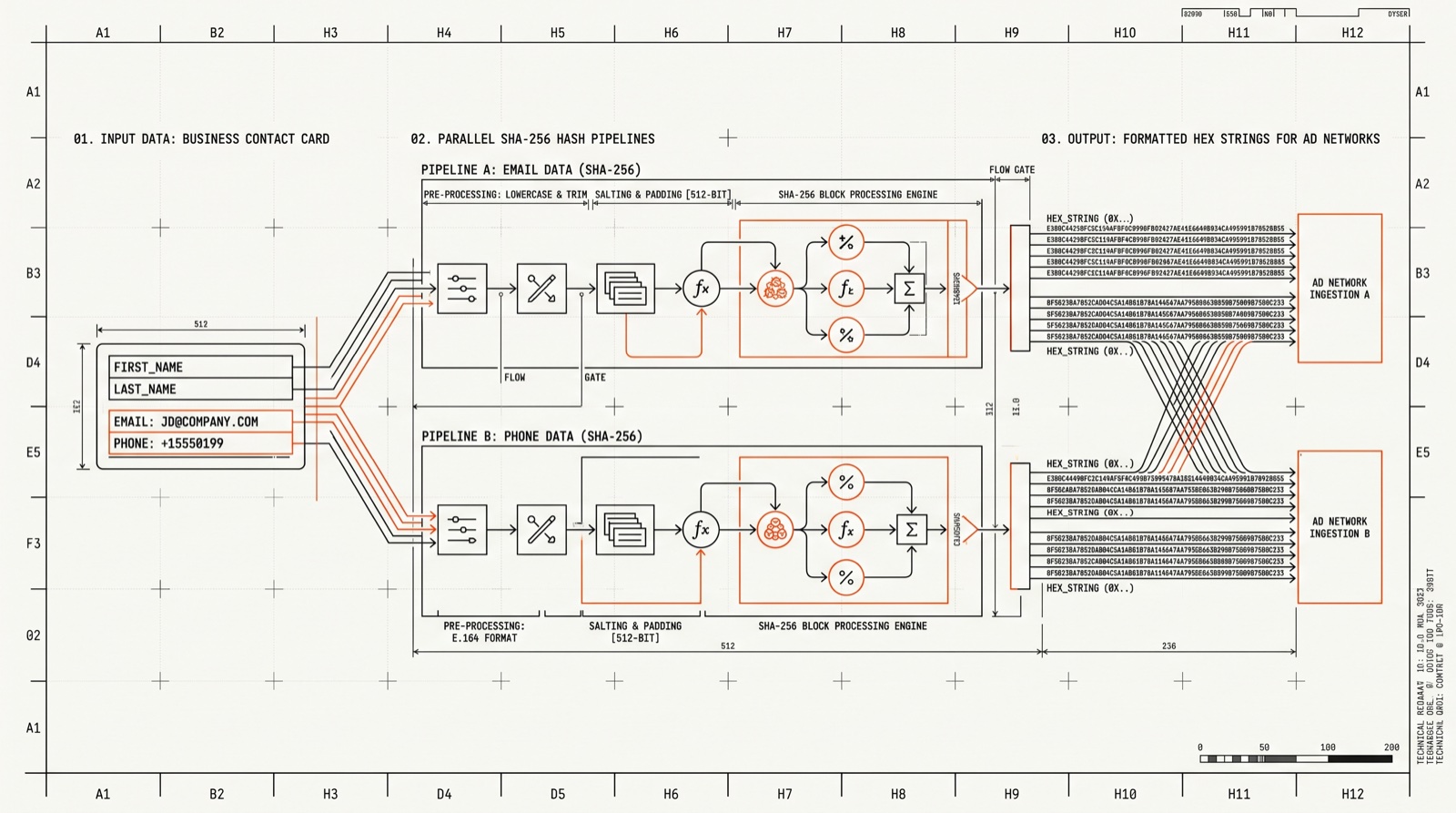
Both platforms mandate unsalted SHA-256 hashing (64-character lowercase hexadecimal strings) after trimming whitespace and lowercasing characters. Because SHA-256 outputs a completely different 64-character digest whenever even a single + symbol or period differs, applying one shared normalization script across both APIs destroys match rates on two critical rules, alongside the blank-cell null-hash trap:
Divergence Rule 1 — E.164 Leading Plus (+) vs. Digits-Only Phone Strings: Google's Data Manager API requires strict E.164 phone formatting that retains the leading + symbol followed by country code and subscriber digits (+14155552671). Meta's Marketing API and Ads Manager Customer File specification mandate stripping every non-numeric symbol—explicitly removing the leading + sign and any leading trunk zeros—so the exact same US number must be hashed as 14155552671. Feeding Google-formatted phone hashes into Meta yields a 0% phone match rate across your entire cohort.
Divergence Rule 2 — @gmail.com Period and Plus-Alias Canonicalization: Because Google's internal account graph ignores dots inside @gmail.com and @googlemail.com local-parts, Google's pre-hash specification requires stripping all periods (.) prior to @gmail.com and stripping +tag aliases (j.doe+vip@gmail.com normalizes to jdoe@gmail.com before hashing). Conversely, Meta indexes the exact literal email string entered when the user created their Facebook or Instagram profile; stripping dots from personal Gmail addresses prior to Meta SHA-256 hashing silently breaks every dotted personal Gmail match in your B2B identity waterfall.
| Technical Dimension | Google Customer Match | Meta Custom Audiences | LinkedIn Matched Audiences |
|---|---|---|---|
| Minimum Serving Floor | 100 active Search users (1k–5k rec.) | 100 matched profiles | 300 matched member accounts |
| Raw Work-Email Match Rate | ~2% floor – 30% | <20% (500 rows → <100 matches) | Moderate to High (Work graph) |
| Enriched Multi-Key Match Rate | 70% – 99% (50–70 IDs/person) | 60% – 75%+ (Up to 99%) | 70% – 99% (Stacked extra rows) |
| SHA-256 Phone & Gmail Rules | +14155552671 · Strip Gmail dots/+ |
14155552671 (no +) · Keep Gmail dots |
1 email column/row (stack personal rows) |
| 2026 Cost & Policy Gates | $50,000 spend + 90d for Targeting; 540d cap; Apr 2026 Data Manager API | ~$7.00–$9.00 CPM; $5/day air cover; 3 email cols/row | $49.37 CPM / $2.29 CPC (TLA); disable Audience Net (19.88% IVT) |
Why Must ETL Scripts Explicitly Guard Against the Empty-String Null Hash?
When preparing multi-column CSV uploads or API JSON arrays where email_3 or secondary phone fields are blank on 40% of rows, naive scripts often run sha256("") on empty cells instead of skipping them. Every blank cell hashes to the exact same 64-character empty-string digest (e3b0c44298fc1c149afbf4c8996fb92427ae41e4649b934ca495991b7852b855)—polluting Meta's 3-column identifier slots and distorting Google Data Manager API ingestion diagnostics. Production pipelines trim whitespace, strip clinical or academic suffixes (Dr., DDS, MBA) from name fields, verify non-empty length before hashing, and output separate Google and Meta columns.
How Does Clean, Zero-info@ Decision-Maker Data Anchor Multi-Channel Micro-ABM?
Every downstream person-level identity waterfall, LinkedIn Thought Leader Ad cohort, and plain-text email sequence depends on starting with verified, active human decision-makers rather than decayed directory exports. If 30% of your seed list consists of departed VPs or info@ reception mailboxes, you burn waterfall enrichment credits and paid ad impressions warming people who cannot buy.
When your seed batch starts with 100% named owners and executives, a disciplined 21-day Micro-ABM cadence compounds across every channel: Days 1 to 14 surround the 300-to-500 cohort with $5/day Meta Custom Audience proof cards and $10/day LinkedIn Thought Leader Ads (keeping Audience Network disabled), while Enhanced-Access Google accounts arm Search Landmine ad groups to capture category lookups. When Day-15 plain-text outbound arrives citing a verbatim operational trigger, prospects recognize the sender name immediately rather than deleting an unfamiliar pitch.
Every 42leads CSV and Google Sheet batch ships with pre-cleaned, honorific-stripped First Name, Last Name, City, State, ZIP, Country, Phone, and Verified Owner Email columns ready for direct outbound sequences and immediate Google Customer Match or Meta Custom Audience formatting:
- Core Pipeline (150 verified US leads/mo): $980/month ($882/mo on 6-month plans; $833/mo on annual).
- Scale Pipeline (300 verified US leads/mo · Most Popular): $1,650/month ($1,485/mo on 6-month plans; $1,402/mo on annual).
- High-Velocity Pipeline (500 verified US leads/mo): $2,450/month ($2,205/mo on 6-month plans; $2,082/mo on annual).
All 3-month, 6-month (-10%), and 12-month (-15%) plans include a $0 setup fee ($750 setup applies only on a 1-Month Flex-Test), 0% info@ in primary rows, a 90-day territory lock, and a contractual <2% bounce SLA with 1-for-1 replacement.
B2B Customer Match & SHA-256 Hashing FAQ
+14155552671) and requires stripping dots (.) and +suffix tags from @gmail.com addresses prior to SHA-256 hashing. Meta requires digits-only phone numbers with country code and NO plus sign (14155552671) and requires preserving Gmail dots and + tags intact—meaning a single shared hash column fails on one of the two platforms.
e3b0c442...) across hundreds of rows—wasting Meta’s 3-column email slots and corrupting Google Data Manager API match diagnostics. Always skip blank cells before running SHA-256.
Start your next cohort with 5 normalized, SMTP-verified US decision-maker rows—Free Custom Sample ($0, zero sales calls).