
The In-House SDR Self-Sourcing Audit: Why Paying Sales Reps to Build Lists Wastes 60% of Their Week
Mapping Salesforce’s 2026 global time-allocation study and The Bridge Group’s SDR compensation benchmarks: how manual list hunting burns $2,625 to $3,000/month per rep, inflates Year-1 meeting costs to $1,630, and triggers a 35-meeting attrition hole.
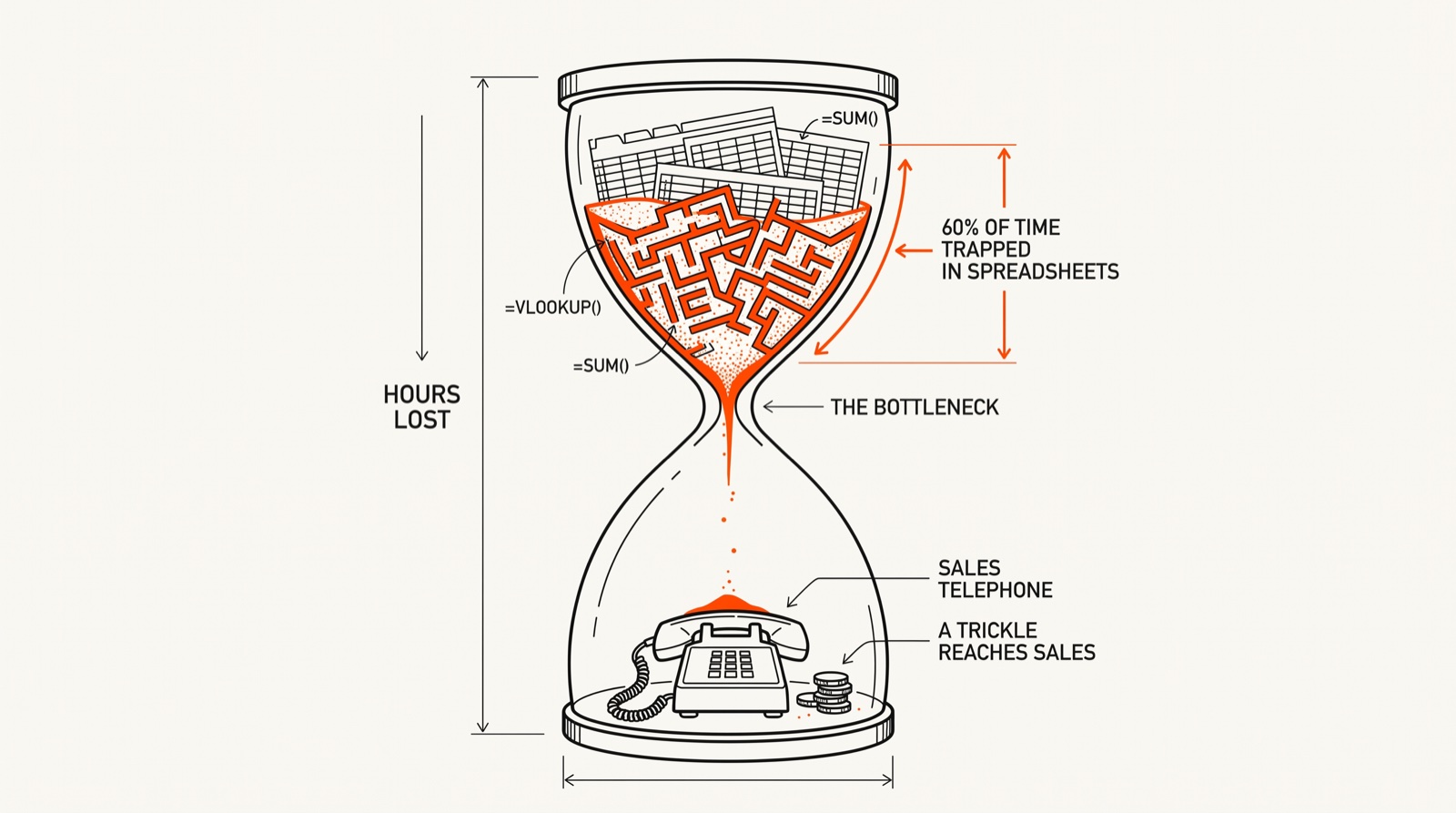
Paying quota-carrying US sales reps to build their own lead lists burns 60% of their workweek on non-selling overhead (rising to 65% among Gen Z SDRs, per Salesforce’s 2026 State of Sales report)—wasting $2,625 to $3,000/month per rep in direct payroll on amateur spreadsheet research and CRM cleanup. According to The Bridge Group, an $80,000 OTE US SDR costs $147,000/year ($12,250/month) fully burdened with manager overhead, logs 112 daily activities for just 4.1 quality conversations (40% phone connect rate), hits only 60% quota attainment, and faces 40% annual turnover—driving Year-1 cost per held meeting to $1,630 and forfeiting 35 qualified meetings per resignation. Handing reps pre-verified weekly signal batches ($980 to $2,450/month—less than one rep’s monthly list-building payroll) reclaims 15+ selling hours per week and protects pipeline when reps churn.
Where Does 60% of an In-House SDR’s Workweek Actually Disappear?
The costliest operational habit in B2B sales leadership is hiring persuasive, quota-carrying human talent and forcing them to spend Monday through Wednesday morning acting as manual spreadsheet clerks. Across Salesforce’s 2026 State of Sales benchmark (4,050 sales professionals across 22 countries), active customer selling accounts for just 40% of the workweek—leaving 60% of rep capacity consumed by non-selling overhead, barely improved from the 28%–30% selling shares recorded in prior editions.
That capacity drain strikes entry-level outbound pods hardest. In the 2026 cohort, Gen Z reps—who represent the overwhelming majority of in-house SDR teams—spend 65% of their week on non-selling work (only 35% selling), losing roughly two additional hours per week to manual data entry compared to senior sellers. Across all outbound roles, 16% of the week goes to internal preparation and planning, and more than 20% (one full workday every week) disappears into manual prospect research and list assembly—leaving 48% of reps reporting they lack the bandwidth to execute consistent cold outreach.
Tool fragmentation and dirty CRM records compound the distraction. The average rep toggles across 8 separate software tools while absorbing up to 275 workplace notifications per day (an interruption every two minutes during core hours). Meanwhile, Validity’s benchmark research confirms that 76% of CRM users rate less than half of their internal CRM records as accurate and complete—a hygiene failure linked directly to an average of 16 lost deals per quarter.
How Much Payroll Is Burned Paying an $80k OTE Rep to Scrape Directories?
Mapping time-loss percentages onto The Bridge Group’s SDR compensation benchmarks (surveying 351 B2B organizations) exposes the unit-economic bleed. Median US SDR On-Target Earnings (OTE) stands at $80,000/year, structured on a 68:32 split ($55,000 base salary plus $25,000 variable commission). Once a CFO adds employer payroll taxes, healthcare benefits (~20%–25% of base), and per-seat licenses across 8 tools, direct monthly outlay reaches $6,500 to $8,500/month ($78,000 to $102,000/year).
Direct payroll is still not the full corporate cost. An SDR Manager earning a median $146,000 OTE supervises a median span of 6.4 SDRs (dropping to just 3.6 SDRs per manager at companies below $5M ARR), adding ~$32,600 per rep annually and pushing total corporate burden to $147,000 per ramped SDR per year ($12,250/month). When an SDR costing $7,500/month in direct payroll spends 35% to 40% of a 160-hour month (56 to 64 hours) hunting clinic owners on Google Maps, cross-referencing LinkedIn tenures, and cleaning bounced CSVs, the company burns $2,625 to $3,000/month per rep ($31,500 to $36,000/year) on manual list-building labor.
Inspect What Your SDRs Open on Monday Morning Instead of Building Lists
Verbatim Public Signal: 2★ Google Review: “Kept on hold 18 minutes just to move my daughter’s ortho checkup.” Running paid Google Ads across 3 Atlanta clinics with no self-serve scheduling.
Verbatim Public Signal: 1★ Homeowner Review: “Submitted an AC outage form at 5:30 PM—nobody called back until Wednesday afternoon.” Paid LSA ads live; static evening web form.
Verbatim Public Signal: 1★ Patient Review: “Requested a full-arch implant consult online twice and never heard from treatment coordination.” High-CPC search funnel active.
Want 5 live, unmasked signal leads in your exact vertical?
Request Your Free 5-Lead Sample Batch →Why Do 112 Daily Activities Produce Only 4.1 Quality Conversations?
The damage of SDR self-sourcing accelerates the moment the rep transitions from spreadsheet assembly to outbound execution. Per The Bridge Group’s benchmark data, an average in-house SDR logs 112 daily activities to generate just 4.1 quality conversations per day—a 3.66% activity-to-conversation yield supporting a median monthly quota of 10 held meetings. At organizations below $5M ARR—where manager span compresses to just 3.6 SDRs per manager—supervisory overhead consumes an even steeper share of customer acquisition margin whenever reps stall on dirty contact exports.
Why does 96.3% of daily activity evaporate? Controlled dialer audits show that phone numbers inside static corporate databases deliver an empirical 40% mobile connect rate (35%–45% range), while the remaining 60% route to medical reception switchboards, disconnected lines, or former staff. Even HubSpot’s productivity telemetry confirms that a typical rep achieves barely two hours of live prospect conversation per day against a full hour of pure CRM data administration. Attempting to brute-force quota through bad data, sales directors place SDRs onto parallel auto-dialers at 300 to 1,000 dials per day. When a clinic owner or HVAC president answers and hears the characteristic 1.5-second parallel-dialer connection delay and transfer beep, they hang up immediately—scorching your addressable market in weeks while driving acute call reluctance. Nearly 50% of reps surveyed in Salesforce’s 2026 study now rank cold calling as the worst part of their job.
How Does the 40% Turnover Spiral Inflate Cost Per Held Meeting to $1,630?
When unverified data starves daily conversations, quota attainment collapses. Only 60% of SDRs hit quota—the lowest attainment figure ever recorded in The Bridge Group’s multi-decade history (aligning with Ebsta and Pavilion’s benchmark showing 78% of all B2B sellers missed quota in 2025, and just 48% of Account Executives reaching annual quota).
Missing commission targets while dialing dead lines drives median annual SDR turnover to 40% (split across 13% involuntary termination, 11% voluntary resignation, and 16% internal promotion). Even the traditional career safety valve—promotion into an Account Executive seat—has narrowed sharply: promotions fell from 34% of SDR attrition in 2020 to 16% recently, while Unify’s longitudinal dataset across 180,000 SDRs shows 12-month AE promotion rates dropping from 11.1% to 7.2%.
With an average SDR tenure of just 1.9 years (23 months) and a mandatory 3.0-to-3.2-month onboarding ramp, companies absorb $21,000 to $36,700 in pre-productivity payroll burn per hire only to capture roughly 19 months of ramped production. Factoring that three-month ramp into Year-1 output puts the true corporate cost of an in-house SDR meeting at $1,630 per held meeting (and $1,220 per held meeting in steady state). Every time a burned-out rep exits, the organization suffers a 2-month vacancy (~20 lost meetings), pays $3,700 to $6,200 in recruiting fees, and funds another 3-month replacement ramp at 50% output (~15 lost meetings)—forfeiting 35 qualified pipeline meetings and over $30,000 in hard replacement burn.
| SDR Economic & Operational Metric | Empirical Benchmark | Pipeline & Balance-Sheet Impact | With 42leads Signal Fuel |
|---|---|---|---|
| Median US SDR OTE & Burden | $80,000 OTE ($55k Base / $25k Var) · $147,000/yr burdened | $6,500–$8,500/mo direct; $12,250/mo incl. $146k OTE manager (6.4 span) | 1 Playbook ($980–$2,450/mo) fuels 1–2 reps; 30% off 3rd+ Playbook |
| Weekly Non-Selling Time | 60% All Reps · 65% Gen Z SDRs | $2,625–$3,000/mo per rep wasted hunting lists & scrubbing CRMs | Reclaims 15+ hrs/wk of pure selling time per rep |
| Daily Activity Yield & Connect Rate | 112 Activities → 4.1 Convos (40% mobile connect) | 96.3% effort lost; 60% switchboard/dead lines drive call reluctance | Active Owner/CEO resolved + verbatim 1–2★ pain context |
| Quota Attainment & Ramp | 60% Quota Attainment · 3.0–3.2 Mo Ramp | $21,000–$36,700 sunk payroll per hire prior to full 10-meeting quota | Day-1 pitch-ready CSV/Sheet; $0 USD setup on 3M/6M/12M |
| Annual Attrition & Tenure | 40% Annual Turnover · 1.9 Yr Tenure | 35 lost meetings + $3,700–$6,200 recruiting fee (>$30k burn) per exit | Institutional pipeline ledger persists regardless of rep churn |
| Cost Per Held Meeting / Lead | $1,630 Year-1 ($1,220 Ramped) | Unsustainable CAC for SMB & lower-mid-market ACVs | $980–$2,450/mo Flat Batches (<2% Bounce SLA) |
How Do High-Velocity Sales Floors Separate Data Engineering From Selling?
Top-quartile CROs treat lead extraction and hygiene as a deterministic engineering utility rather than a rep-level chore. Instead of allowing an $80,000 OTE seller to waste $2,625 to $3,000/month copy-pasting directory listings, they hand every rep a pre-verified morning queue where every row already pairs an active Founder, Owner, CEO, or Managing Partner (0% info@ in primary rows) with verbatim public 1–2★ customer review proof and paid-funnel conversion diagnostics.
42leads structures its monthly packages around single-rep and multi-rep weekly capacity (“1 Playbook = Weekly fuel for 1 Sales Rep”, with a 30% discount starting on your 3rd parallel Playbook):
- Core Pipeline (
150verified US leads/mo · 7.5/working day): $980/month standard (-10%on 6M;-15%on 12M). - Scale Pipeline (
300verified US leads/mo · 15/working day · Most Popular): $1,650/month standard (-10%on 6M;-15%on 12M). - High-Velocity (
500verified US leads/mo · 25/working day): $2,450/month standard (-10%on 6M;-15%on 12M).
Every 3-month, 6-month, and 12-month plan carries a $0 USD setup fee ($750 one-time setup applies only on a 1-Month Flex-Test), a strict <2% bounce SLA with 1-for-1 replacement, a 90-day territory lock, and a Free 5-Row Custom Sample ($0, unmasked CSV, zero sales calls) so your reps can dial and email verified owners before you spend a dollar.
Three Questions on In-House SDR Economics & Self-Sourcing
1. How much does a single in-house US SDR actually cost per year when management span and tools are included?
According to The Bridge Group benchmarks, median US SDR On-Target Earnings (OTE) is $80,000/year ($55,000 base plus $25,000 variable). Adding payroll taxes, benefits, and 8 per-seat software licenses brings direct cost to $6,500–$8,500/month ($78,000–$102,000/year), and factoring in first-line SDR Manager overhead ($146,000 median OTE across a 6.4-rep span) brings total corporate burden to $147,000/year ($12,250/month).
2. Why do parallel auto-dialers accelerate SDR burnout and territory exhaustion in local B2B markets?
Legacy B2B contact databases deliver only a 40% mobile connect rate, with 60% of numbers routing to front-desk switchboards, wrong contacts, or disconnected lines. Placing reps on parallel auto-dialers at 300 to 1,000 dials per day introduces a 1.5-second connection delay and audible transfer beep that causes decision-makers to hang up immediately, burning addressable territories while making cold calling the most disliked task for nearly 50% of sellers.
3. How many qualified meetings does a B2B company lose every time an in-house SDR resigns?
With a median quota of 10 held meetings per month, every SDR departure triggers an average 2-month hiring vacancy (~20 lost meetings) followed by a 3.0-to-3.2-month ramp at roughly 50% average output (~15 lost meetings), totaling 35 lost qualified meetings plus $3,700–$6,200 in recruiting fees and over $30,000 in replacement burn.
Stop paying $80k OTE reps to scrape spreadsheets—hand your team 5 unmasked US Owner + pain-signal dossiers free.