
The HVAC & Home Services Signal Playbook: Turning Municipal Permits, Missing Booking Widgets, and 1-Star Reviews into Pipeline
How home-services marketing agencies and field-service SaaS teams combine live DOM gclid inspection, after-hours conversion leaks, municipal permit surges, and state contractor license DBA filings to reach verified fleet owners.
LinkedIn-based B2B databases miss 85%–90% of profitable HVAC, plumbing, roofing, and electrical fleets because trade owners rarely maintain corporate social profiles, while raw Google Maps scrapers trap reps at dispatch@ and info@ radio desks. For home-services marketing agencies and field-service SaaS teams, the highest-converting outbound play pairs active Google Ads detection (gclid conversion tags) with missing post-6:00 PM online booking widgets—a funnel leak worth +22% in booked service trucks—reinforced by county mechanical permit surges and verbatim 1–2★ dispatch complaints. Cross-referencing state contractor license numbers and DBA-to-LLC Secretary of State filings then unmasks the actual Qualifying Individual or President under a verified <2% bounce SLA.
Why Are 85% of Profitable HVAC, Plumbing, and Roofing Fleets Invisible in Legacy B2B Databases?
Selling performance marketing retainers, AI voice dispatchers, fleet telematics, or field-service management SaaS into skilled trades exposes an immediate coverage wall in people-first databases. Platforms like Apollo, Lusha, and ZoomInfo build their graphs from LinkedIn profiles and corporate SaaS org charts. Yet an owner operating a 12-truck residential air-conditioning fleet in Tampa or a 38-truck commercial mechanical contractor in Phoenix generating $8M in annual service revenue has zero operational reason to maintain a LinkedIn profile. Across local skilled-trade benchmarks, Apollo captures fewer than 15% of active operating contractors—matching roughly 20% of local owners, 10% of direct emails, and 7% of direct phones—forcing tens of thousands of competing agencies to hammer the exact same 15% minority every morning.
Pivoting to cheap Google Maps scrapers like Outscraper or D7 Lead Finder solves listing discovery (85%–95% of trade storefronts appear on Maps), but collapses at identity and deliverability. Raw website crawlers pull the emergency dispatch number and generic info@ or service@ addresses staffed by dispatchers paid to prioritize burst water mains and failed rooftop chillers—not agency discovery calls. Winning multi-truck trade accounts requires verifiable ad-funnel and public-record signals paired with statutory contractor license resolution.
1★ Facility Manager Review: “Emergency rooftop chiller fault called in Monday morning—no dispatcher called back for 36 hours.” Static contact form; no urgent triage widget.
Active Google Ads gclid conversion tags on seasonal tune-up landing page, but zero online slot-booking widget after 6:00 PM + 14 municipal HVAC permits filed in county.
2★ Google Review: “AC died Saturday evening—left two voicemails on the answering service and ended up booking another company.” Paid search active; no SMS web chat.
Want 5 live, unmasked signal leads in your exact vertical?
Request Your Free 5-Lead Sample Batch →The 6:00 PM Money Leak: Why Active Google Ads + Missing Booking Widgets Is the Ultimate HVAC Signal
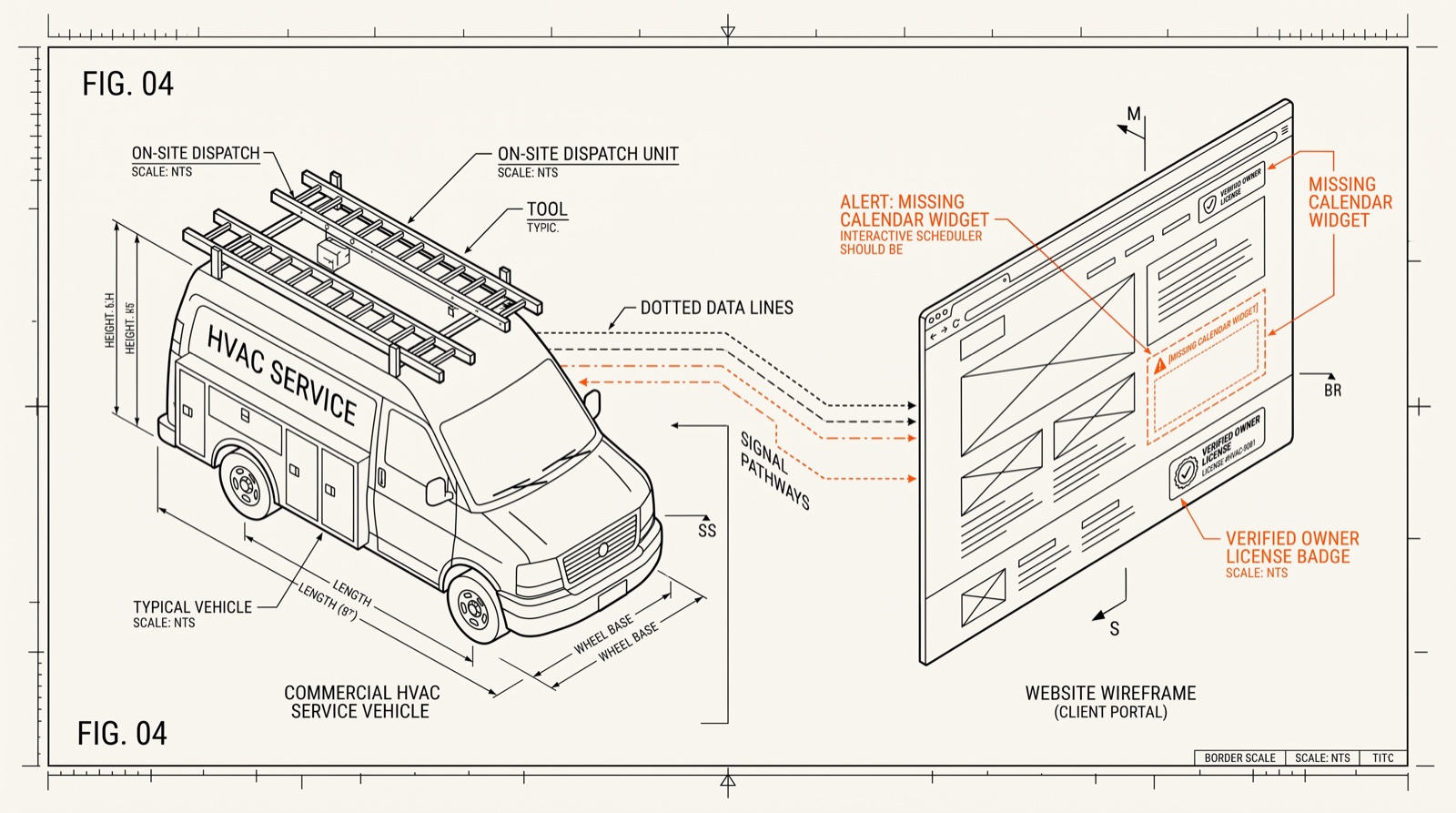
Static technographic databases rely on cached DNS lookups that routinely miss or misreport embedded scheduling calendars loaded dynamically on contractor landing pages. A production home-services extraction pipeline renders every contractor's homepage and paid landing pages in a real browser to isolate one high-margin gap: active paid search spend paired with a missing after-hours booking calendar.
Specifically, our crawler checks for Google Ads conversion scripts, gclid / wbraid URL parameter handlers, CallRail dynamic number insertion, and Meta Pixels, then simultaneously checks for live dispatch calendars (such as ServiceTitan Schedule Engine, Housecall Pro online booking, or Jobber instant scheduling). When a homeowner returns from work at 6:30 PM to a warm house and clicks a $45-per-click HVAC search ad, hitting a static “We Will Call You Tomorrow” contact form causes immediate abandonment to the next competitor offering instant evening slot selection. Across state-level HVAC benchmarks, converting evening form-fills after 6:00 PM into live dispatch calendar bookings lifts booked service trucks by 22% without adding a single dollar of Google Ads budget.
Catching this gap reliably requires full browser rendering rather than cheap HTML text scrapers. Modern field-service tools like ServiceTitan Schedule Engine, Chirp, and Podium Webchat load interactive booking popups and chat widgets dynamically as the page finishes rendering—causing basic HTTP scrapers to flag false positives constantly. By verifying live booking widgets alongside call-tracking scripts (CallRail, WhatConverts, Invoca), an engineering-grade pipeline separates contractors actively spending $5,000 to $25,000/month on local search from dormant brochure websites.
How Do Municipal Mechanical Permits and Verbatim 1–2 Star Reviews Multiply Urgency?
Website conversion gaps prove structural leakage; public permit registries and timestamped customer complaints prove immediate capacity strain. When municipal building and mechanical permit feeds show an uptick in commercial rooftop unit (RTU) retrofits, heat-pump replacements, or residential panel upgrades—or when seasonal heat waves and freeze events spike inbound call volume—under-automated dispatch desks buckle. Scraping 1★ and 2★ Google reviews with strict character-for-character verbatim substring verification isolates explicit dispatch failures: 36-hour callback delays on chiller faults, missed four-hour technician arrival windows, and unanswered weekend answering services.
Triangulating municipal mechanical permit counts with Google Maps review velocity and commercial fleet filings also solves the chronic SMB sizing problem in skilled trades. A solo owner-operator running a single van out of a residential driveway cannot afford field-service SaaS seats or $3,500/month agency retainers, whereas an 8-to-50-truck contractor pulling dozens of monthly county RTU and heat-pump permits loses $8,500 to $28,000 in replacement gross revenue every time a high-intent evening emergency lead abandons a static web form.
| Extracted Field Signal | Deterministic Detection Layer | Best-Fit Outbound Offer | Quantified Operational Benchmark | Diagnostic Opener Angle (Passes Creepiness Filter) |
|---|---|---|---|---|
Active gclid + Static Form |
Live rendered landing-page script audit | PPC / CRO Agencies & Booking Widgets | +22% booked service trucks after 6:00 PM | Visual mockup of instant evening slot-booking on their current tune-up page |
| 1–2★ Callback / Voicemail Pain | Verbatim review substring gate | AI Voice Receptionists & SMS Intake SaaS | Captures missed weekend/surge emergency calls | Frame as peak seasonal surge overflow audit—never criticize dispatchers |
| County Mechanical Permit Spike | Municipal building/RTU permit feed | Fleet Financing, Equipment & FSM Software | Confirms multi-crew commercial install volume | Benchmark dispatch triage & job-costing velocity across 20–50 truck fleets |
| State License + DBA → LLC | ROC / TDLR / CSLB / DBPR + SoS UCC | All B2B Home-Services Vendors & M&A | 75%–90%+ Owner match vs. ~20% in Apollo | Routes directly to Qualifying Party / Managing Member (<2.0% bounce SLA) |
How Do State Contractor License Boards Unmask DBA Trade Names into Verified Owners?
In residential and commercial trades, the consumer-facing brand painted on the service van is frequently a registered fictitious trade name (“Doing Business As” or DBA)—for example, Lone Star Comfort Air operated legally by Miller Mechanical Holdings LLC. Generic domain enrichers search LinkedIn for the DBA brand, find zero executives, and fall back to info@.
Fortunately, almost every US state legally requires mechanical, plumbing, electrical, and roofing contractors to display their state license number in website footers and truck signage (such as TACLA in Texas TDLR, ROC in Arizona, CSLB in California, and CAC/CFC in Florida DBPR). Querying state licensing registries by license number or physical yard address deterministically exposes the Qualifying Individual (the master license holder) alongside the exact legal corporate entity name. Cross-referencing that corporate entity against Secretary of State LLC/corporate officer filings isolates the active President or Managing Member, whose direct corporate email is then verified via two-stage live SMTP and catch-all resolution.
Equally important in 2026, Secretary of State and UCC lien cross-checks filter out private-equity rollups masquerading as local family trades. Across Sunbelt metros, institutional consolidators acquire regional HVAC and plumbing brands while keeping legacy local DBAs on the trucks; corporate officer and registered-agent resolution immediately flags whether five regional domains trace back to one centralized PE platform or represent independent founder-led fleets with autonomous budget authority.
How Does the Signal-Angle-Line Framework Pass the Contractor Creepiness Filter?
Trade fleet owners have zero patience for aggressive cold emails claiming their website is “broken” or naming an angry reviewer to insult their dispatchers. High-converting outreach translates raw technical scrapes into a helpful Diagnostic Audit:
Instead of writing “Your site has no booking widget and losing leads,” top-performing home-services agencies write: “Noticed your team is running seasonal tune-up search ads in Maricopa County, while homeowners landing after 6:00 PM currently hit a static contact form rather than a live dispatch calendar. Across Arizona HVAC fleets, converting evening form-fills to instant slot-booking typically lifts booked service trucks by 22% without adding ad spend. Mocked up how a live dispatch calendar looks on your current page—open to a 60-second look?”
Rather than spending $6,235 to $11,430/month maintaining brittle DIY scrapers, residential proxies, and internal GTM engineering hours, home-services agencies and field-service SaaS teams run predictable monthly batches with 42leads—featuring 0% info@ in primary rows, a <2% bounce SLA with 1-for-1 replacement, and a 90-day territory lock:
- Core Pipeline (
150verified US leads/mo): $980/month standard (-10% on 6M; -15% on 12M). - Scale Pipeline (
300verified US leads/mo · Most Popular): $1,650/month standard (-10% on 6M; -15% on 12M). - High-Velocity (
500verified US leads/mo): $2,450/month standard (-10% on 6M; -15% on 12M).
Every 3-month, 6-month, and 12-month plan includes a $0 USD setup fee ($750 setup applies only on a 1-Month Flex-Test), and you can test our state contractor license resolution first with a Free 5-Row Custom Sample ($0, unmasked CSV, zero sales calls).
HVAC & Home Services Signal Outbound FAQ
gclid parameters proves the contractor is actively spending capital on customer acquisition, while the absence of an asynchronous dispatch calendar means homeowners landing after 6:00 PM hit a static Contact Us form. Across residential HVAC operators, converting evening form-fills into instant slot-booking lifts booked service trucks by 22% without adding ad spend.
Test 5 unmasked HVAC, plumbing, or commercial mechanical contractor dossiers in your target US state—100% free.